My Battery is toast

Collapse
X
 
  • Time
  • Show
Clear All
new posts

  • MaximPhil
    replied
    Hi TC,
    I see you write the change date on your battery too My experience this summer was that after 3 1/2 years exactly the same time as yours my Everstart battery was no longer holding a charge for more than a few days.
    With my planned ride to North Carolina I decided to replace it with another off the shelf at WalMart. I was satisfied I had my moneys worth out of it.
    Most of our motorcycles sit for extended. periods of time which is hard on wet cell batteries.
    Phil

    Leave a comment:


  • TopCatGr58
    replied
    Keeping you abreast!

    Okay folks,

    I know how we like photos, and I had taken a bunch several years ago when I first installed this new battery, to make a tech tip about what to do when you install a new battery, etc., but never got around to posting them.

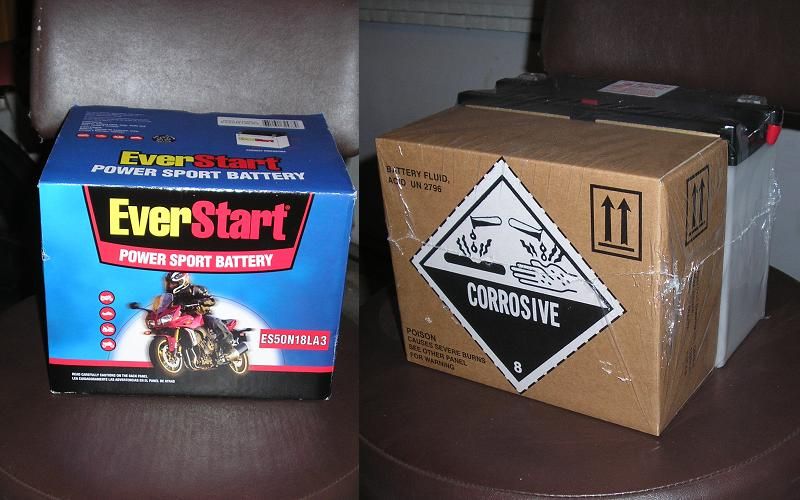
    Okay, just showing the packaging for the Walmart brand, that it comes with the battery and acid packed separately, it's "dry charged", and you get to add the acid once you get it home.


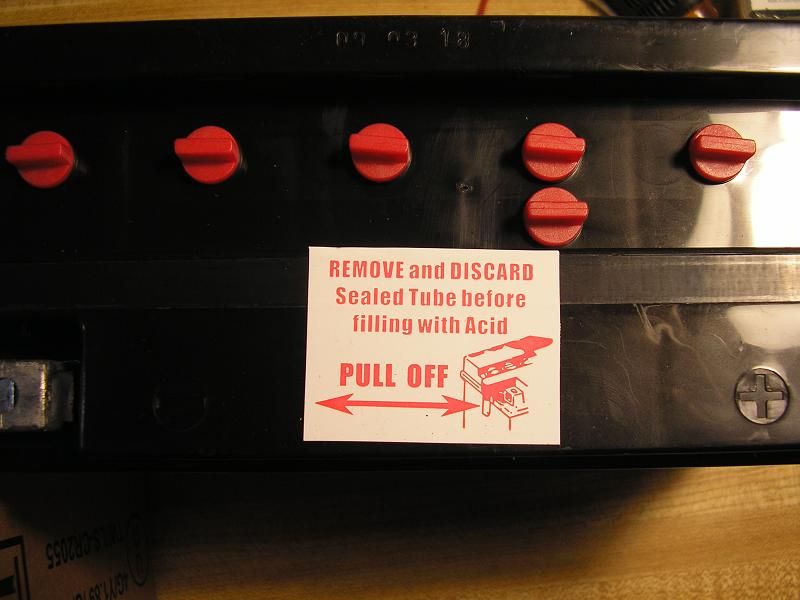
    Just a warning about removing the drain hose port cover so that it can vent when you add the acid as well as charging later.


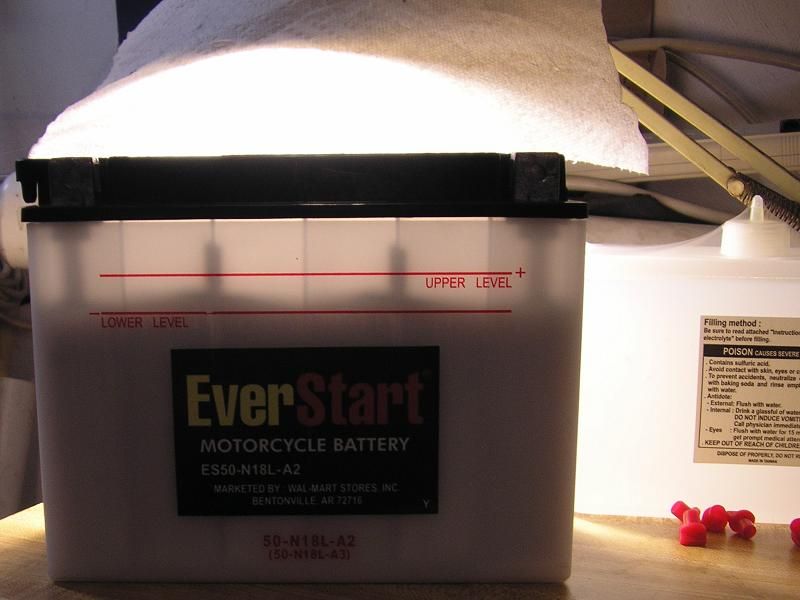
    Showing a backlit view so you can see the dry cells, and the low and high water indicator lines.


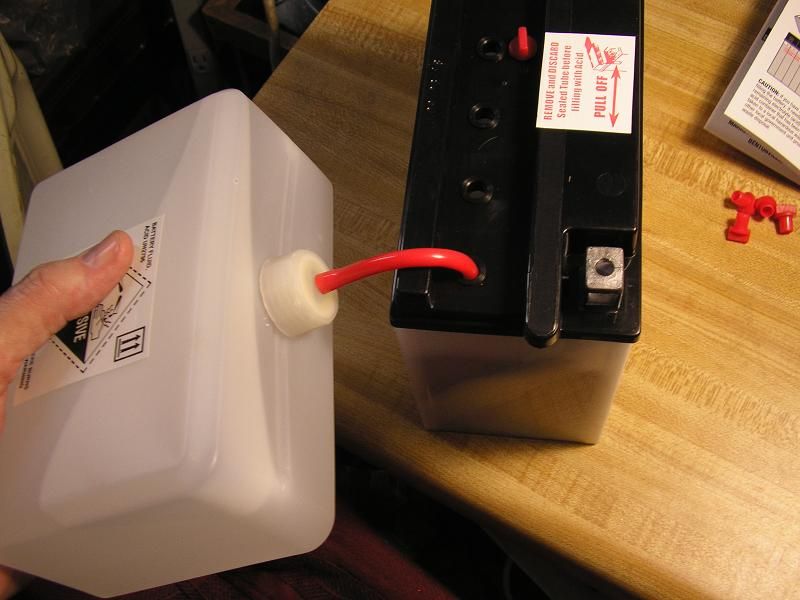
    Here I am adding the electrolyte, it comes with a handy little hose, I should have been wearing gloves! Having the backlit helps to visualize the fluid levels without having to stick your face/eyes directly OVER the battery filler holes, fumes and such!
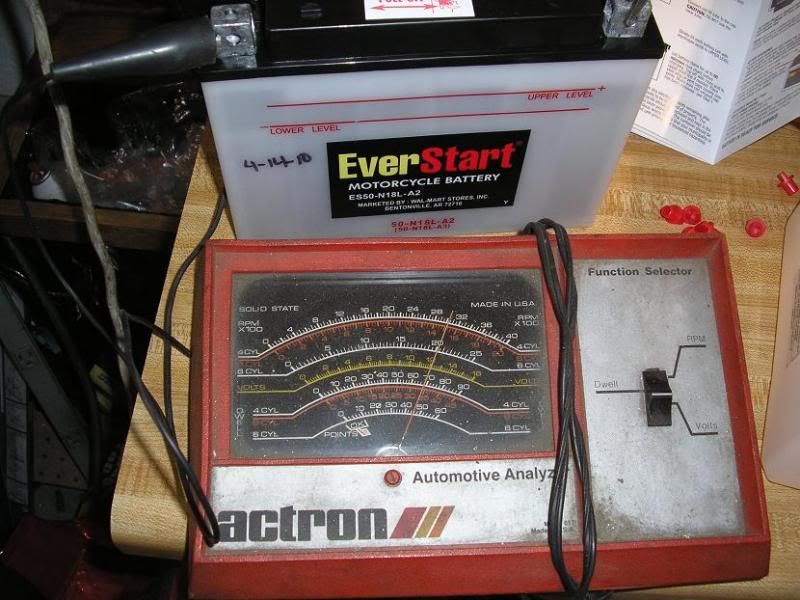
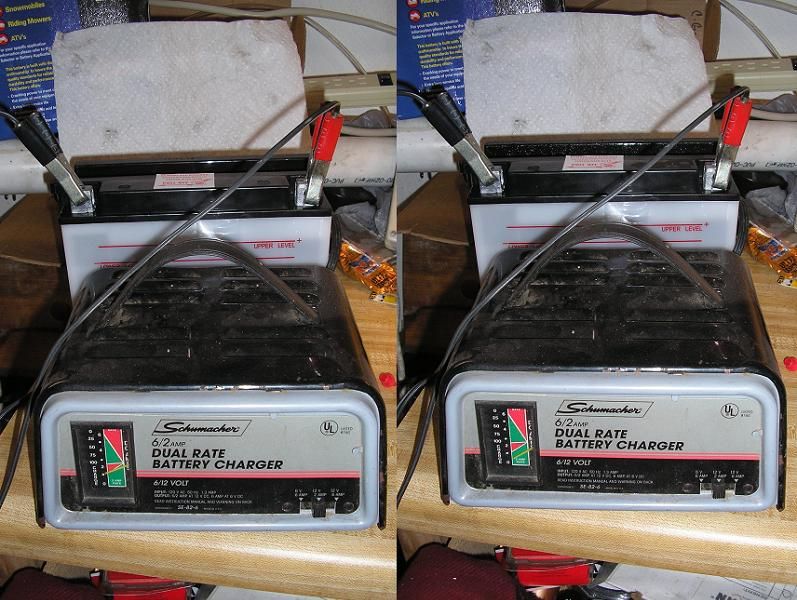
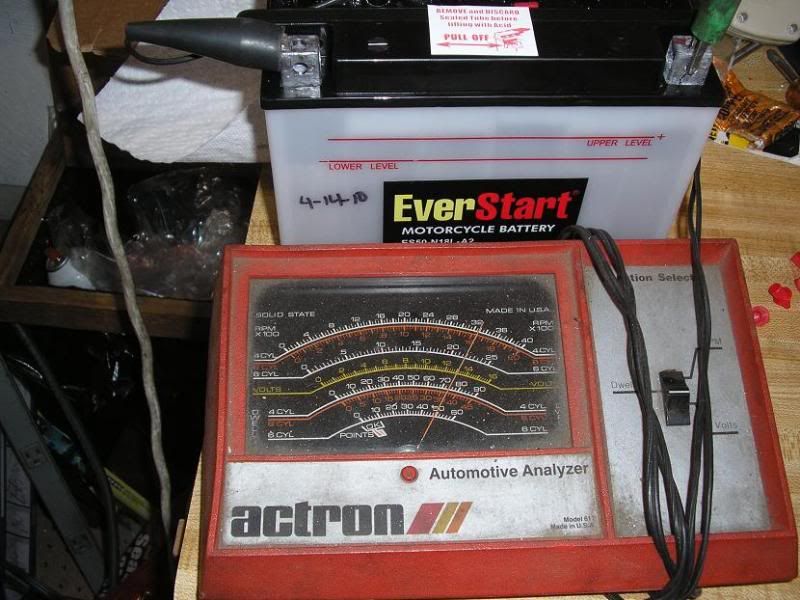
    Next just shows the barely 12 volts reading on the voltmeter after putting in the electrolyte.


    These show it first being on the 2 amp charger...and then after it's been on for some 10 or so hours after it's reached it's full charge potential. IT's highly recommended to do this BEFORE you ever put the battery into service.


    And the final voltmeter reading showing a good 13 volts after the charge.


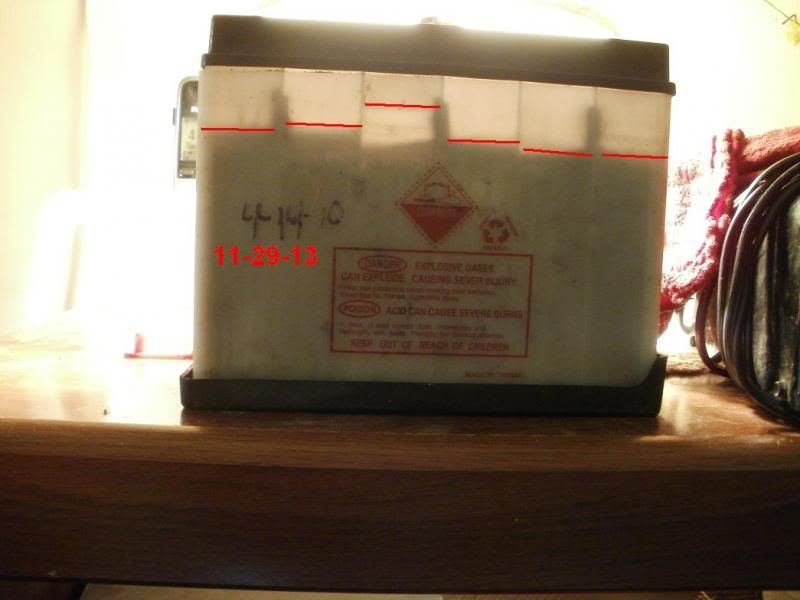
    Now the same battery some 3+ years later, after it sat in the garage for 2 months and allowed to go totally FLAT, and apparently it also ran low on water. I had filled it up just prior to going on the Rally Ride in Sept.! Some of you will also remember that I'm using the Mini-Race Alternator, it does put out a lot more power than the OEM REG/RECT/ALT combo, but I've got a voltmeter on it, and it doesn't go above 14 or so volts while riding, so I don't think it's getting OVERCHARGED while riding, just that the air has been quite dry around here, and it's just slowly evaporated over the last 2 months that it's been sitting....it's NOT been on a trickle/float charger!


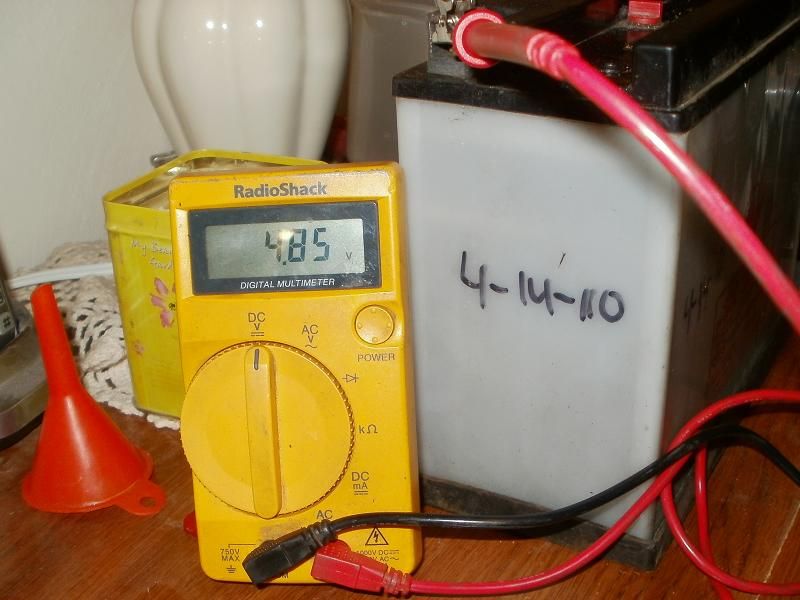
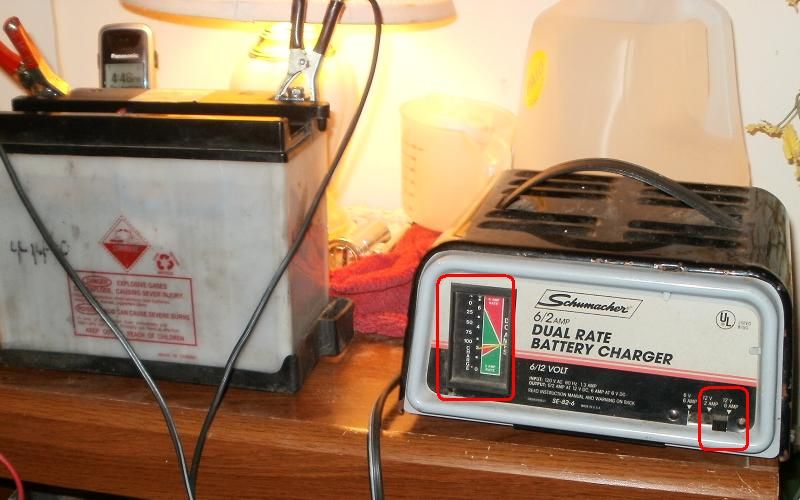
    A couple of days prior to this, I had mentioned that I had tried to charge it with the same shown charger, first on 2 amps for a day, and then on 6 amps overnight! Then just let it sit for a day or so until I got new fancy Pulse charger...and so the voltmeter shows not quite 5 volts!


    Put it on the same charger in the 6 amp mode for about an hour.


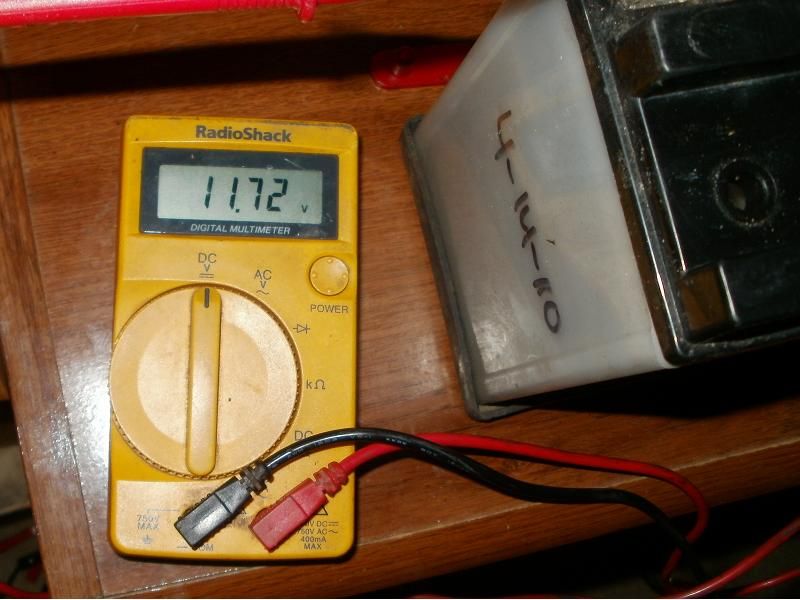
    And then the voltmeter shows it got up to almost 12 volts....needed to get it up to 10.5 or more before being able to hook up the fancy PULSE charger..needs the 10.5 minimum for it to work...apparently will sense the volts and such.


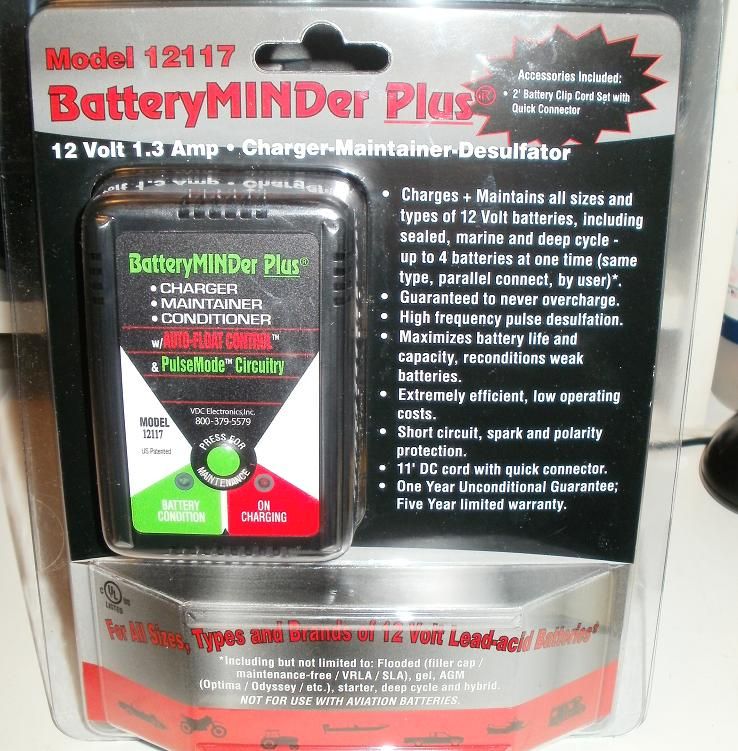
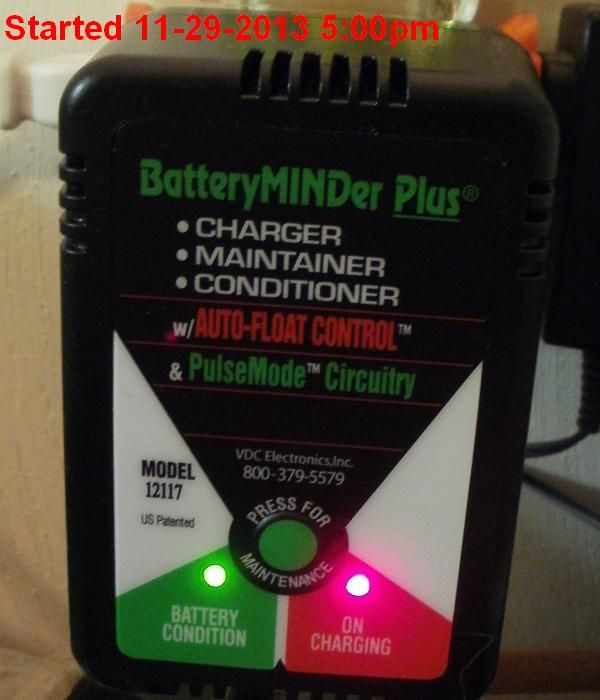
    The Pulse Charger/Minder has 2 LEDs, left one just verifies that you have it connected to the battery correctly, and the right one shows that it's in Charging mode....it automatically goes into PULSE/Conditioning/Charge mode. You can select to put it in the FLOAT mode with the center button.


    As has been mentioned it can take a few WEEKS for it to work on the sulphates and such. Some of the other research and reading I found stated that the hard crystals that have formed deep in the main base structure of the plates don't come off easily or at all with the PULSE chargers. That the plates are made with a Lead Calcium, and that there is a THIN layer of Calcium Oxide that form between the outer layer of the Paste/Plate, and that the PULSE charger works on THAT layer, and can help increase the conductivity at that level.

    Their research...they built cells within glass containers so that they could see the changes that occur to the plates, as well as then examine them closely afterwards. They found that the PULSE chargers didn't do much to the hard crystals, and that they were only able to bring the batteries up about 20% of capacity once the plates are heavily sulphated !

    SO....I may not be able to actually resurrect this battery to normal potential?
    Automotive starter motors usually draw about 100 amps, and so with batteries that have 600+ CCA capacity allows them to survive and function for several years as they slowly SULPHATE and loose their capacity, and it's only when they(Auto sized batteries) get near or below the 100 CCA range when they finally are considered "DEAD", not strong enough to Start the engine...and this usually takes some 5 years.

    Our batteries are smaller and usually only about 250 or so CCA's. I think our starters don't take as much amperage as a car starter, perhaps 50 or so. And so again with regular usage, the bike batteries slowly sulphate and loose their CCA capacity which many of us have learned/experienced to be about 3 years.

    However, this loss of capacity and sulphation occurs when the batteries are not FULLY charged back up to their capacity when not in use. Once they are fully charged, the electrolyte is mostly high concentration Sulfuric Acid, and can be stored IN THE COLD just fine for quite some time. The cold slows down the self discharge rate, and the high acid level prevents freezing. It's still recommended to give the battery a TOP OFF charge once a month. The higher the acid concentration the less tendency for the battery to sulphate. When the battery is allowed to discharge...the chemical reaction that the Acid does to the lead plates, turns to lead sulphate and water, and free electrons. SO....keeping the battery as fully charged as possible converts the mild layers of lead sulphate back into LEAD and sulfuric acid, but can consume some water when the charging goes too far/overcharge...there's no more sulphate to convert, so it then turns to ELECTROLYSIS of the water and that's when it can "boil" away along with releasing hydrogen and oxygen gasses.

    So....float charging does NOT damage the batteries provided it's enough current to truly keep the battery fully charged, provided it doesn't go into GASSING mode which then runs the electrolyte DRY/below the plate levels.

    T.C.

    Leave a comment:


  • madmax-im
    replied
    After reading about this type of charger i think i will hit the local Northern tool and pick up one...it can maintain up to 4 batteries...so that works fine for my 2 bikes...Thanks for the FYI TC, Brian and CZ...

    Leave a comment:


  • madmax-im
    replied
    Interesting Hijack TC...whatever else you do pls rewire that switch...On a sidenote... I ordered my battery from Battery Mart on Weds and its scheduled for delivery sometime today...coming from Winchester VA...so if it weren't for the holiday I would have had it in 1 day...and free shipping...whats not to love?
    Good luck TC on your quest at battery redemption...keep us updated...

    Leave a comment:


  • b.walker5
    replied
    Would be very interested in hearing the outcome of this, in particular, how long the battery lasts after 'resurrecting' it.

    Youre quite correct. Most people dont know the difference between a 'trickle' charger, which charges at a constant low current, and doesnt shut off, and a 'float' charger, which is what youre looking at.

    A worthy read for anyone with battery issues, or for those who dont want them.

    Battery University™ is a free educational website offering hands-on battery information.
    Last edited by b.walker5; 11-28-2013, 04:27 PM.

    Leave a comment:


  • TopCatGr58
    replied
    Hey Brian and CZ,

    Well, today I've been doing a lot of NET research, first learning the basic chemical reactions involved in a lead/acid battery, the formation of the lead sulphates, and such, what kills a lead/acid battery of the life of the battery...the formation of the harder lead/sulphate crystals that don't break down easily back into lead and sulfuric acid components with regular charging. Found/Read about the fellow Couper in 2000 that developed the PULSE charger that uses the high frequency high voltage low amperage pulses that attack the hardened crystals without overheating the rest of the plates and such. Found links to electronic hobbyist type sites where folks have built their own pulse conditioner, but that's too complicated for me.

    CZ, thanks for the link, that is the brand of the least expensive Conditioner/charger/minder that I found, but that one is a more expensive later model. Northern tool still has their cheaper earlier version that is still from the same company, quality device, and with a local Northern Tool I can save SHIPPING!!! Same price on Ebay but with ~$8.00 S&H.
    http://www.northerntool.com/shop/too...2201_200332201

    Yes, I learned that this takes quite some time to work, but it's now winter, and I'm not riding the bike now, so I have no problem with plugging it in and letting it sit for several weeks. But I'll do a quick charge of the battery to see if it can take a surface charge and have the minimum voltage that will show that there's enough plate surface to be able to recover/condition with the PULSE technique.

    This type of Minder which has the ability to break down the lead sulphate crystals sounds like the newer type that will NOT damage batteries vs. the older simpler just trickle charging types that can let the lead sulphate crystals form over the years, and may also be why some folks feel that they are bad for batteries. Lead acid batteries will form these crystals just through normal use/discharge/recharging cycles.

    Will let folks know what I find, what I get, and how it works out!

    T.C.

    Leave a comment:


  • CaptonZap
    replied
    Howdy TC

    If you finances can handle it, buy one of these
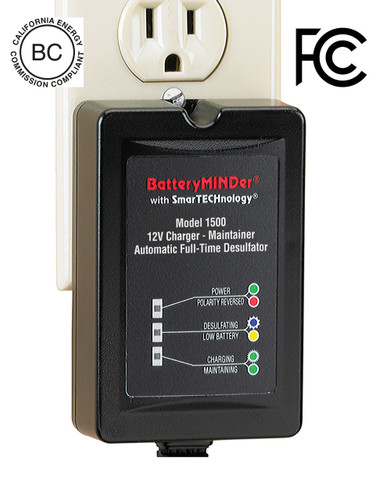
    BatteryMINDer 1500 12 volt 1.5 amp temperature compensated charger desulfator extends battery life up to 4x when compared to new, non-maintained batteries.

    If the battery is savable, this will do it. It is not an instantaneous process, so let it set for a few weeks. Also, the battery has to be above 10.5 volts for it to work. If you can put 10 amps to the battery for a few minutes, (watch the heat buildup), you can sometimes slough off some of the sulfate, and get the voltage to come up.
    I have also put another charger on it to bring the voltage up, and hooked the BM charger in parallel with it.
    I have a Variac with a bridge rectifier that I use for various purposes, so I can jack the voltage up to whatever it takes to get the amps I need. You might have to improvise.
    (Car alternator with the regulator disconnected and a jumper wire from the battery to the field?)
    If you don't save it, you have a charger that will prolong the life of your new battery.
    And with some jumper wires connected to all the small batteries in you garage, you can keep them all topped up with one charger.
    One good point is that the charger is under warrantee for a number of years, (ask them the number), made in the USA. I had them exchange one that was 6 months past expiration of the warrantee, which I thought was a nice gesture.

    CZ

    p.s. Wire that thing properly.

    Leave a comment:


  • b.walker5
    replied
    Some chargers 'claim' they can resurrect a completely flat battery, and to be fair, some of them can, but it's usually on a battery that has been run flat i.e. below 1.0v, and is recharged immediately. A battery thats been dead for some weeks is likely to stay dead, and even if you do manage to get some charge in, the likelihood is that it wont hold it. If it's a wet cell, there is a battery conditioner available, which is basically a little bottle of sulphuric acid, which is supposed to revive them, but from my experience, it's only a short term fix, and more often than not is only delaying the inevitable.

    Bottom line is sulphated plates is terminal, and replacement is the only real option.

    If your going to keep the relay switch in place, I would be rewiring it through the key, to remove the need for memory.

    Leave a comment:


  • TopCatGr58
    replied
    Hijack alert!!

    Hey folks,

    Okay, I'm honestly admitting to hijacking this thread, but it is on topic!

    Okay, a while back I had a headlight relay failure with regards to the ALT trigger wire, so I bypassed it, ran a switch to the handlebar to throw the relay to turn on the headlights. That switch was powered with an all the time hot wire, not controlled/switched by the ignition key switch.

    This summer/fall after I had rigged up the switch, I had left it in the ON position, not knowing that it would draw power from the battery to energize the headlight relay? I ran my now 2 year old standard battery DEAD! I was able to put it on my charger and got it back up to essentially full strength, worked fine while I attended the FALL Rally.

    Got the bike home, unloaded and parked it. I thought I had remembered to turn the headlight relay switch back to the OFF position, but I may have forgotten again! But it's been over a month or so since I had gotten back, and hadn't run the bike so I don't know how long the battery had been drained dead. We were starting to get some moderately cold weather for our region and I was wanting to "top off" the charge to help it endure the colder weather storage.

    But to my surprise I found the battery totally DEAD. So..I'm assuming that it's been for several weeks or more, and from my understanding this is when they form SULPHATES on the plates which essentially truly kills them so that they will not take a charge, or if they do, it will only be a little surface charge and will not have the amp depth to function properly!

    I put it on the charger at the 2 amp level, and the next day, almost NOTHING from it...have a pair of aux driving light I can switch on to check to see if the battery will work. I then put it on the 6 amp mode overnight, next day the aux lights would work, so I put it back in 2 amp mode, and that evening again almost NOTHING.

    So..I'm assuming I've sulphated and truly killed this battery prematurely!?
    I haven't searched the "net" yet, but remember reading about some special chargers that use some PULSE technology to try to blast/vibrate the sulphate from the plates??? Any suggestions in trying to resurrect this battery?? Tapping it with a rubber mallet to shake the sulphate from the plates???

    Another surprising thing I noticed while I still have the battery in the bike/harness, was that once I removed the power from the charger, I noticed this strange gurgling sound coming from under my mini-race-alt cover, and when I put my hand on the cover, it was slightly WARM..not hot?? This mini-alt is the ONE WIRE directly to the battery design, and it has built in reg/rect. I'm wondering if due to the resistance of the now dead and possibly sulphated battery, that the charging current was backfeeding to the mini-alt, and hopefully wasn't frying the reg/rect components????

    Anyways, I'll be removing the battery from the frame before attempting any additional chargings of it.

    T.C.

    Leave a comment:


  • madmax-im
    replied
    Originally posted by motoman
    It is for Madmax-im also...........if one can take the summer humidity.
    already have an adequate charger see above...and yeah i can ride all year round...if i want to... and i dont winterize my bikes down here either
    Last edited by madmax-im; 11-27-2013, 09:00 PM.

    Leave a comment:


  • motoman
    replied
    Originally posted by b.walker5
    The little charger shown with the battery would be a good investment as well, if you dont already have one. It appears to be a proper float charger, and will keep your battery in good nick over your winter storage period. (we dont have one here, our riding season is 12 months long)
    It is for Madmax-im also...........if one can take the summer humidity.

    Leave a comment:


  • b.walker5
    replied
    The little charger shown with the battery would be a good investment as well, if you dont already have one. It appears to be a proper float charger, and will keep your battery in good nick over your winter storage period. (we dont have one here, our riding season is 12 months long)

    Leave a comment:


  • madmax-im
    replied
    great discussion and now that the $ is in the bank...I've decided to go with this one...as noted earlier... Thanks to all for their comments and suggestions...
    http://www.batterymart.com/p-Big-Cra...xj1100-battery

    Leave a comment:


  • jetmechmarty
    replied
    My seat of the pants experience says AGM is better. I rarely charge my batteries. I just ride the bikes. The AGM batteries are serving me far better than any flooded wet cell (or whatever you call it) ever did. FAR FAR BETTER! YMMV.

    Leave a comment:


  • b.walker5
    replied
    The electrician in me has to agree to disagree with some of your points.

    Not to say that your personal experiences arent valid, but theres absolutely no reason, in fact plenty of evidence to the contrary, why an AGM shouldnt last as long, or longer than a standard wet cell. As you said, there basically no different than a wet cell. except the electrolytic is held in a fibre glass matt right next to the plate. This allows for lower discharge, as youve indicated, but it also allows for higher current flow, faster charges rates, and less susceptibility to vibration, which as we know, along side poor maintenance, is a major cause of sulphation.

    Leave a comment:

Working...