
In the carburetor schematic it is referred to as the nozzle main. it is item 52 in the Partzilla link I posted earlier. The main jet screws into it. There is a washer underneath the main jet. As Shming stated once you remove the main jet and washer a wood dowel of the proper size can be used to tap the tube out or as I suggested a float bowl screw can be used. If you just screw it in just enough to get a good bite enough of the screw protrudes above that gives you enough room to get the tube moving down by lightly tapping on the screw. A wood dowel is a safer bet from start to finish. The varnish that builds up, and for sure has in your carbs from the condition of the other parts you posted pictures of, can make it more difficult to remove and can also block the holes in the tube. The reason I said soak the carbs in Berryman's before disassembling. My concerns are that without a thorough cleaning from this point forward you are never going to really get the carbs to perform properly. You will fight problems from here on out. At least at this point when you suffer performance issues you will know that the problems are probably the carbs.
I might add that there have been numerous discussions on what purpose those holes in the tube serve. They are sold today with holes and without holes and both seem to work. We say clean them because, obviously clean is better and allows the flow of fuel air much better.
-
The needle jet screws into the emulsion tube from the float chamber side/bottom of the carb. The main jet/needle jet holds the emulsion tube in place. using a proper sized wood or plastic dowel the emulsion tube can be tapped upwards into the venturi and out so it can be cleaned. There are small holes on the sides that have to be clear to achieve proper emulsion of the fuel and air.Leave a comment:
-
Thanks Cajun. So uh what is the emulsion tube? I don't see it listed on the carb parts diagram. I'll try google.. The needle jet?
Leave a comment:
-
Good luck with the bike. Hope it runs well enough for you to enjoy it. I edited my post and your copy of my post when you replied so that folks reading this post won't be misinformed. It was concerning the emulsion tube removal. Fixed now.Leave a comment:
-
So you guys will laugh...
Got the carbs back on and the tank and fuel lines all buttoned up and turned it to prime and it started right up. Wow. SWEET! ( or so I thought. ) I went around and was putting the side covers and seat back on it and looked and saw fuel dripping!!! From the carbs. So I thought anyway. In my head I'm screaming NOOOOOOOO!!!!
 All that for nothing!
I turned off the fuel and then looked CLOSELY and determined the fuel was dripping down from a hastily attached fuel line to the T on the right side. Lmao. I told you guys I suck at mechanically inclined stuff.
Anyway I cleaned that all up and reexamined the other side too and pushed them all on a little farther and buttoned up the air box and left the air filter section off and rode it for a mile and parked it in the garage.
I plan to ride it to ping pong at the Rec Center in the morning as it's first real test ride of a few miles.
I know there's a lot more I SHOULD DO to the carbs but I don't feel qualified to do it. You guys point out parts and things to do and I have NO IDEA what you refer to. I just wanted to start by addressing the immediate problem. The bogging and fuel leaking into the air box. BikerPhil's use of the part# and the correct carb diagram on Partzilla gave me my first clue TO WHAT THE HELL I WAS TRYING TO DO. I don't know a needle jet from a hole in my head.
Now I KNOW I can get them off and reinstall them. Even tweak 'em a bit. I expect something else will go wrong but you guys have given me a bit of hope that I might be able to repair it myself. I'm no LAB3 or the guy in Holland who fabricates his own parts and built that bad-ass turbo, of that I've no doubt. I figure I've earned my yellow belt in Ya Ma HA. lol
Thanks. I'll let you know if I'm crying like a little school girl if she runs poorly tomorrow.
Last edited by JonnyO; 03-04-2025, 08:22 PM.Leave a comment:
-
Yeah...hands on is the only way but I usually try to learn, first hand, from someone experienced with whatever the heck it is I want to do. That's just me. Reading about doing it is a frickin' waste of my time. I've got to do it to "get it".
The main jets... I BOUGHT FROM A YAMAHA DEALER! That's disappointing to find out. But I believe you know what the hell you're talking about. smh.
Cajun, as it stands I did EXAMINE the pilot jets and they looked ok-to me-could see though 'em; put 'em back in. I polished the seats with some Mother's mag cream as suggested and my little dremel buffers. I also ( pic below ) found some crusty residue ( don't know what else to call it ) in the hole where the assembly sits. Weird. Scraped it off with an exacto...CAREFULLY. Reinstalled assemblies with new o-rings and gaskets.
I was told to adjust the float height and sync the carbs after replacing the o-rings. The thing ran great before it started to act up. I guess my first clue ( don't know if any of you have experienced this ) should have been firing it up and being able to drive it right away. I mean stone cold it wouldn't hesitate or buck like my experience has been if you don't warm a bike up a bit before trying to ride it. I WAS GOING TO SAY SOMETHING but what? "Hey, why does my bike run perfect when it's stone cold"? Didn't think that was a good question for the board of inquiry.
I'm being told to do THE JOB RIGHT by cleaning and inspecting a bunch of areas and parts I HAVE NO IDEA on how to do. So I ain't going to...AT THIS POINT. For me, half the battle was remembering how everything came apart and goes back together. I'm not good with that. I'm shocked I got it back together. lmao
But I did. Last edited by cajun31; 03-05-2025, 01:24 AM.
Leave a comment:
-
As cajun31 stated, be careful with the pilot jets and to add to that I have a screw driver that I purposely ground for a tight fit for the pilots. In fact I fashioned a number of tools just for carbs and don't use them for anything but carbs. You're gettin' there.Leave a comment:
-
Jonnyo, now you are in the process. Really the only way to learn. If you want to keep the bike you have to get past the learning curves involved in maintaining it. Took my time and really studied your pictures. First things first. Your main jets are aftermarket. I would replace them all or go back to the originals if you still have them. Jets R Us is a good source for those. As for the float pins if you can sand them smooth and they are not in the least bit warped you can reuse them. I always replace them. The new pins available today don't press in; they just slide in and out. No fear of breaking the posts in the future. You are going to have to get the pilot jets out and you have to be careful there as well. They can sometimes be difficult and they too are brass and are easy to destroy. If you mess up the slot on them you then have to drill them and use an extractor to get them out. If you break the extractor you are pretty much screwed on that carb body. Best bet is to soak those carbs in a gallon can of Berryman's then things would come out much easier. I know you don't want to break the entire bank of carbs apart, which is what most of us do but you could just soak two carbs at a time. It would make all the components loosen up making them much easier to remove to inspect. Just looking at how hard you had to work at the float valve seat is evidence of the fact that you have a lot of buildup and crud in those carbs. As was mentioned earlier you need to get the emulsion tubes out too. The main jet is covering that up but it is probably in need of a good cleaning too. The easiest way to get those out is to remove the main jet and washer, screw one of you float bowl screws down in the tube and with a very light hammer tap on them. I guess the main thing concerning the disassembly process is to leave your gorilla mode aside and take your time. When frustration levels rise step away and soak some more. Berryman Chem-Dip Carburetor and Parts Cleaner 96oz .Last edited by cajun31; 03-05-2025, 01:22 AM.Leave a comment:
-
And hoping the little teeth marks on the outer side will do nothing...?
Leave a comment:
-
-
So again, how do you guys remove, what/how do you grab the thing to get it out? I saw one youtube short vid where the guy used a tap to get a bite on it and yanked it out but this is not feasible as I'm just replacing the o-ring and wish to reuse the needle assembly.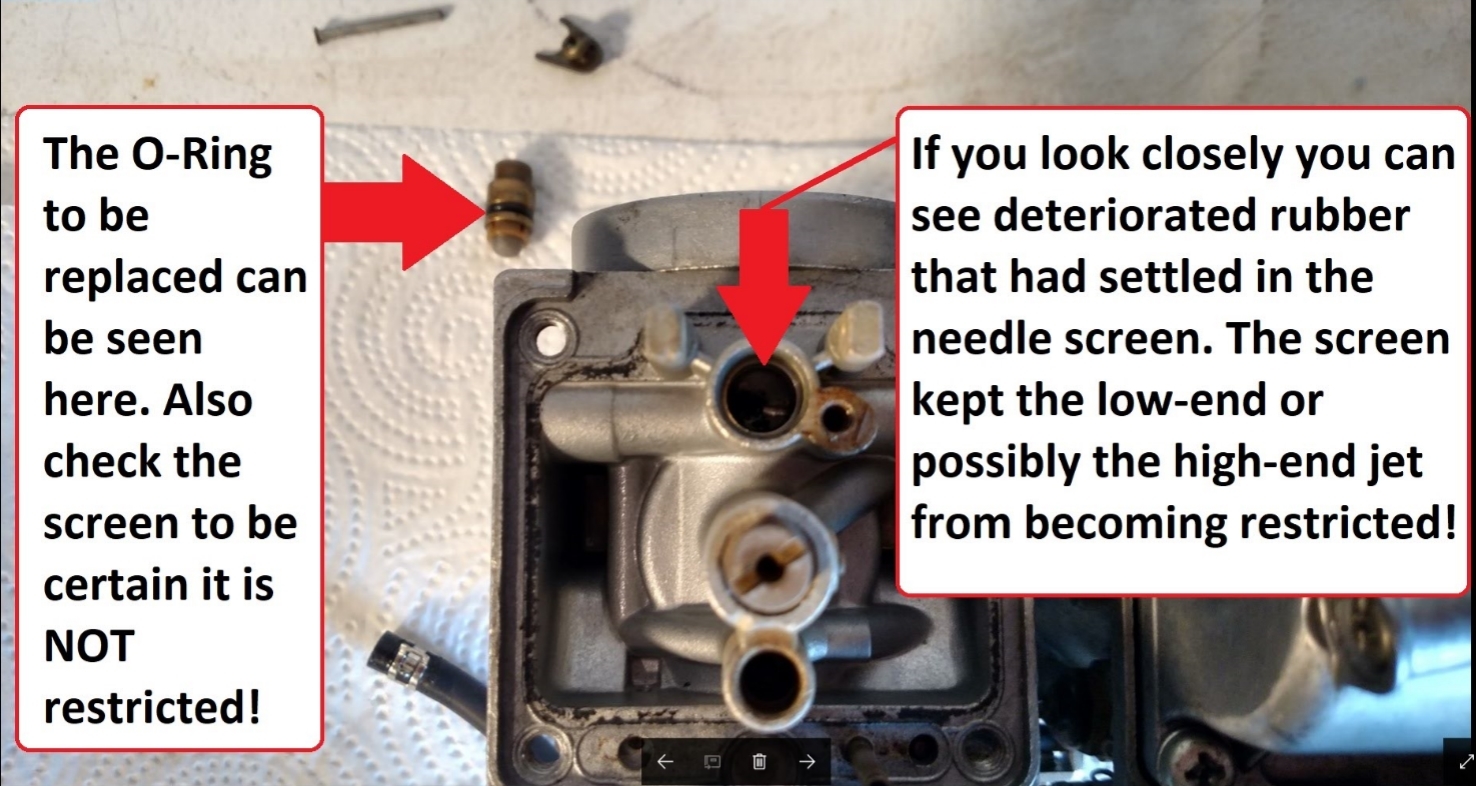
Leave a comment:
-


Leave a comment: