Soldering vs Crimping

Collapse
X
 
  • Time
  • Show
Clear All
new posts

  • Larrym
    replied
    Every Day is a Parade

    Thanks steve,

    We're in that "violent agreement" about using the tinned marine wire. (There's a "Worst" Marine store nearby and I use the marine grade connectors/wires as a general rule.) Most of the wires/connectors that I have had to address problems on (my bikes, vehicles, and those of friends...) did use copper stranded.

    If I were to replace a wire altogether my choice is to use the $$$ tinned wire. Really nice to see each individual strand tinned separately. Mostly though, it's only the end of an untinned copper wire that I'm working on. In order to "tin" the wire end myself I have to unpack the soldering iron, tin the wire end, and crimp the connector on. Doing it that way makes the whole wire end one solid "lump" I have to try and compress with the crimpers. (Crimp it like I'm a McGilla the Gorilla...GRUNT!!)

    That takes care of the dissimilar metals issue. The soldering of the connection is prob'ly just due to the fact that my soldering iron is out/hot already. Or maybe rather than tin the wire in a separate action, I crimp the copper wire in the connector and then solder/tin in one operation. That way I get the copper wire strands to conform/max contact with the crimp shape.

    I guess that for me and the high humidity conditions I face, (the XSeption by the looks of it), I have to apply new rules of engagement for dealing with the corrosion enemy: Whatever It Takes.

    Which brings me round to how come there in Yelm, you're not automatically a part of the conflict? Wha' sup with that?? Are you in the rain shadow of the Olympics?? I know you're on the "WET" side of the Cascades same as me. Not on the water but certainly near it. Tarzan in Spokane is on the DRY side: Just look at the brown wheat fields in July round that area. It's like he's surrounded by one of those giant dessicant/Gel packages or something.

    BTW. Nice thread here ya got going. Gives people like me a chance to not exactly rain on their parade, but rather to let'em know that my parade gets rained out regularly.

    Leave a comment:


  • crazy steve
    replied
    Larry, probably the main thing you're suffering from is the wrong wire; if you're using bare copper wire, it doesn't like marine environments or any place that's highly corrosive. They make a 'marine-rated' wire that's fully 'tinned' (each and every strand) and that's what you want. Not cheap, but it would go a long way towards preventing that nasty 'green' from showing up...

    '78E original owner

    Leave a comment:


  • Larrym
    replied
    But where I am.....

    Originally posted by clcorbin
    Larry,

    I bet you HAVE seen a LOT more issues with moisture where you are at than here where I am at (Albuquerque, NM, a high desert)!

    So what have you found that will actually keep water out of the connection all together? There has GOT to be something that will work!
    I guess that's sorta the point in the original title of this thread: Soldering vs Crimping. Each one of us gets to make his/her own decision based on different factors like preferences, convenience, longevity, etc. I extend the benefit of the doubt that each owner has chosen the "side" that works for their bike and has a well reasoned "argument" with supporting evidence/facts. None of us would knowingly do something cheap, cheezy, or just plain wrong to our bikes, right??

    Point is that every one of us is making that decision based upon the conditions we see when we look out the window. (For some of us it's raining right now....) Geography, weather, and environmental conditions like temperature, relative humidity, etc, apparently does play a role in what goes on at the wire-to-connector crimp.

    Larry I have no doubt you've seen some failed joints in a "Marine" environment but to be fair our bikes arent exposed to the same conditions on a daily basis so glue filled heat shrink isnt likely to present the same problems.
    Not just "some" but most of the failed joints leave the finger of blame pointing straight back at corrosion. At least for me in my experiences here. And I do so love statistics: Likely, probable, unlikely, improbable, etc. It's real fun to do the math sometimes. But in real life for me at least when I say, "What were the chances of that happening??", when I encounter a failed crimp-to-wire. I have to respond, "Apparently 100% now that it has and is right in front of my face."


    I'd love to be back in Arizona where I could say, "Rust?? Corrosion??? We don't have any steenking Corrosion!!" So those of you in a desert, (whether it's high or low...) might take a moment to appreciate what you have by comparing it to the heroics someone else might have to perform in order to keep their headlights from going dark. What may work for you might just be a recipe for an "equipment failure", an awkward conversation with an officer of the law, and a promise to pay promptly at the nearest available courthouse for me or someone in a similar environment.

    So I've found something that works: making the crimp and then soldering afterwards. (Those of you applying sunblock right now need not read any further.....) The "adhesive-lined-shrink-tubing" fails to provide anything more than a temporary nuisance to corrosion/infiltration and once the enemy has gained a foothold that very same "protection measure" accelerates the corrosion process. Period. (at least for us here in the CCZ:"Corrosion Conflict Zone...).

    I seriously compare that tubing to the way that the "Great Wall of China" was supposed to keep everybody safe from the Mongol hordes. Historically it was only a minor obstacle to ole Genghis Khan. (Like he must've laughed long and hard at that one..) The chinese were using the "enemy at the wall" mentality. Build a wall around the Country and that'll keep the bad guys out.

    Genghis proved that didn't work. So the chinese built walls around their villages. Didn't stop the barbarians from robbing and pillaging at their leisure. Neither did fortifying the individual houses where the rich would cower hoping to avoid Genghis's lances/arrows/blades. The body count of nobles was largely unaffected.

    So the notion that keeping the enemy forces out by building walls/barriers was an epic fail: based on a recurring defense strategy applied each time even though it the strategy itself was flawed as seen through the eyes of a dude who hadn't even graduated grade school. He just recognized the flaw and optimized it.

    So what to do...what to do??? The wall/barrier around the country didn't work. Neither did the boulders stacked around the village. The sharp spikes pointing outward from the house failed. The enemy is inside my living room: armed and dangerous!!! Welcome the the concept of a "Resident Evil". (Video game was spectacular!!!) The enemy is right there next to you, "Living with you."

    That's why I use the solder. It's like the actual connection is involved in direct hand-to-hand combat with corrosion. It's not "defenseless" and hoping against all hope that shrink tubing is gonna keep it safe. And the solder's Kung-fu is strong. The outer layer of the joint is a line where corrosion is "constructively engaged" but will not usually break through to the vital paths which electrons must follow. On a molecular level the blow-by-blow attack and defense continues with the solder soldier countering every poke/jab the corrosion barbarian makes. Locked in never ending battle.

    That is until I relocate to Arizona or somewhere similar. Then I won't even have to use connectors at all. I can just twist the wires together and use 3m electrical tape. Or if the wire has to fit around a screw, my usual laziness of forming the wire end into a "J" and slipping it around the shank then tightening it down. Ta Dah!!! Good to go.

    Looks like I'm gonna have to move there anyways: I simply won't have my XS suffering all the other evils a constant high relative humidity brings.

    Leave a comment:


  • b.walker5
    replied
    Larry I have no doubt you've seen some failed joints in a "Marine" environment but to be fair our bikes arent exposed to the same conditions on a daily basis so glue filled heat shrink isnt likely to present the same problems. I have used hundreds of metres of the stuff over the years from ultra low voltage connections to high voltage (1kv and over) underground cable joints and have personally never seen a failure caused by moisture seeping in. (seen plently of failures for other reasons).

    The brand I use the most is heavy walled Raychem ATUM from the TYCO (Take Your Company Over) group and it's extremely good quality. it's type-approved (Thermoform tubings) by the American Bureau of Shipping (ABS) and Det Norske Veritas (DNV), and Lloyd’s Registry of Shipping. If its good enough for them it's good enough for me.

    I still like soldering and combined with good heat shrink gives you a very good joint.

    Leave a comment:


  • DiverRay
    replied
    I use the marine grade heat shrink tube from arrow. I buy mine at West Marine, or at a local electronics store. It IS the same grade that is used for underwater splices on AC ELECTRICAL connections, such as pumps for fountains.
    ANYTHING will fail with time, it's just a matter of how much time BEFORE it fails. The crimp tool is MY best friend for new or replacement ends, but I STILL solder and shrink splices, as they seem to hold up better for me.

    Leave a comment:


  • clcorbin
    replied
    Larry,

    I bet you HAVE seen a LOT more issues with moisture where you are at than here where I am at (Albuquerque, NM, a high desert)!

    So what have you found that will actually keep water out of the connection all together? There has GOT to be something that will work!

    Leave a comment:


  • Larrym
    replied
    The Cold War ...The Wet Trenches...

    Originally posted by clcorbin
    Real world equals wet/damp equals adhesive heat shrink to seal them up...
    Thanks Clint.

    Yeah. Maybe that'll work: Adhesive shrink tubing. (A little ray of hope in this dismal dark war against the elements and their relentless attack on my XSes wire-to-connector fittings.) At least they'd have something like a shield to protect them when going into battle, right??

    "Raise Shields and Hold your Position, little Guys. The enemy is Advancing!!"

    IMO: Optimism to the point of foolishness. I've seen the aftermath of that battle and the survival rate on the field wasn't good. The little adhesive shields appear to work at first but in the end the enemy (Moisture/Corrosion) wins through the never ending siege and sinister tactics like infiltration. (Moment of silence for all the connections who used that adhesive backed shield and fell never to rise again.)

    I might approve the Shield (adhesive backed shrink-tubing) for the support troops, like a splice in the wire:


    Like a good field dressing applied by the medics, it'll keep out the "infection" and allow the soldier to be productive again.(temporarily) Notice how the adhesive does a good job of sealing on the sides of the splice where all it has to do is surround one wire's insulation and hold tight. No water likely to get inside even if I hit it with a high pressure spray. But if you look closely, you'll see this is not a splice to repair a break in a single wire: there's another smaller wire added to the other side of the tubing. The gap between those two wires inside the heat shrink is a security breach which the enemy (Moisture/corrosion) will not fail to recognize and use to their own benefit: an indirect, slow assault using the atmosphere. Silent...out of sight...and yet right under our noses. The shield itself serving to provide cover for their ongoing assault: "Trojan Horse".

    It's what they do. It's all that they do. They don't stop. They don't get tired like you and me. It's a welcome matte and don't think they don't appreciate the invite.

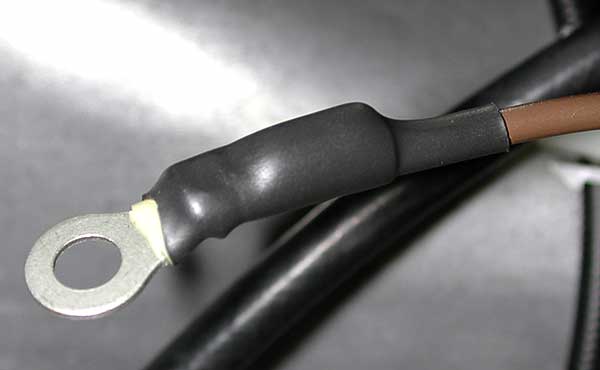
    The Front Line Soldier Suited up for Battle:


    Looks good to the casual glance. Tubing is providing adequate support at the right side to mitigate any vibration or stress/strain. To the left though, I see only the minimal length of tubing covering that crucial "contact" between the stranded wire/crimp underneath. The tubing "shrunk" but in that process, the main "force" is at the edges of the flat shaped ring. Little if any force on the actual flat area on top/bottom. Only the glue inside to keep it pressed against the surface to achieve/sustain that necessary "atmospheric seal". Anyone can take a small jeweler's flat-bladed screwdriver, try to insert it under the ringside of the tubing and verify for yourself whether or not that "seal" is there or just an inconvenient illusion.

    I've been the one who has removed the tubing afterwards (months/years later of course) and seen the results: the crimp/connector is usually wet/corroded yet still "physically" holding everything together. But usually I'm investigating underneath only because electrcalonically the test measurements or the function of that circuit has led me to this skunk-in-the-woodpile. It's a regular occurance...a "repeat offender" in my wet and damp world.


    IMO: might keep any direct frontal attacks like rain from hitting the inside but that area at the left is a weak spot. Once the atmosphere gets in the wire-to crimp is vulnerable. Not going to send this private in to battle for a full tour of duty prepared like this: he won't make it back home to get a job with the civil service. I send this soldier back to the medics to get the "soldering" which so far has allowed others to hold their ranks together and keep holding them


    Where I am, the marina has rules about the use of 120 VAC "extension cords". Specifically, between the shore power supply and the boats they require a "30 Amp" Marine Power Cord to connect from the supple to the vessel. That's a little too pricey for some folks so they try to compromise by using this:


    A regular extension cord then runs from the pigtail end to the boat. The people then wrap the pigtail-to-extension-cord with electrical tape as a protection measure against moisture/rain. Should be good enough, eh?

    Definitely not. Over time this "protection/seal" ends up failing spectacularly: Fires. Reason is that although the tape might keep the rain from directly hitting the exposed gap between the male/female ends of the plug-in, over time moisture gets in through via the air. (No way that electrical tape reaaally provides an air-tight seal...) Then the same electrical tape "barrier" serves to keep the moisture from getting out. In the end it's like a damp/hot greenhouse under that "impermeable barrier". (Thank you Mr. Murphy!) That accelerates any and all moisture/corrosion processes so in far less time than one would expect: Epic Fail. (Did I ever mention that I was a fireman??)

    Thing is that some folks have thought about the limitations of electrical tape and even had the correct sized glue lined shrink tubing somewhere on-hand. Good for them!! In the end the same epic fail occurs: moisture gets past the "impermeable barrier" and then accelerates the process. Maybe a little longer until it happens but it eventually does. When the marina tells these guys that they can't get by with what they are using the argument begins.

    "But it's sealed. It's not unsafe.." and they point to their well executed shrink-wrapped connection. "See???"

    Civilians. They don't know the enemy. Can't understand the need for every millimeter of protection or advantage.

    As far as applying "glue-lined-shrink-tubing" to "protect-and-seal" on my XS?

    Have it. Use it. Like it. But only for electricalonic insulation and strain relief.

    I solder before I put it on.

    Leave a comment:


  • clcorbin
    replied
    Originally posted by psycoreefer
    Is the main advantage of the adhesive heat shrink that it seals out moisture? Cuz I can do that with regular heat shrink and grease.
    Yes. The hot glue makes a very permanent seal against the elements. I have no DOUBT that putting grease around the connection before sliding the regular heat shrink tubing over it is MUCH better than just heat shrink, but it will not do as good a job as adhesive heat shrink tubing.

    The big difference is that the hot glue is pretty much set once the tubing cools. It will not work it's way out due to movement/vibration/time/pressure changes/etc like the grease will. The stuff just doesn't go anywhere.

    About the only problem with the stuff (other than the added expense and harder to find) is if you ever need to remove the heat shrink, it is a royal pain in the butt as it is glued down VERY well to the wire and the connection.

    For those of you who asked where to get it, here is a link to Mouser Electronics and their 3/16" x 4' adhesive lined heat shrink tubing: 3/16 x 4' adhesive heat shrink.

    Needless to say, they have lots of other sizes as well from 1/8" all the way up to several inches.

    Leave a comment:


  • trbig
    replied
    Look on Ebay for heat shrink. I bought 20 feet of some good, high temp stuff to go over my old plug wires to keep them from arcing when wet. I paid less for that with shipping than I did for one of those small bags of 6" pieces you find at the hardware store. I remember seeing the kind with the glue/epoxy stuff also.


    Tod

    Leave a comment:


  • crazy steve
    replied
    No, it's also to 'glue' it in place so it can't slip if the wire is bent. The glue actually adds to the 'strain relief' part of using shrinktube by making the insulation a more 'continuous' piece. If you're installing a splice someplace where you know there's going to be movement, this is the stuff to use...

    '78E original owner

    Leave a comment:


  • psycoreefer
    replied
    Is the main advantage of the adhesive heat shrink that it seals out moisture? Cuz I can do that with regular heat shrink and grease.

    Leave a comment:


  • crazy steve
    replied
    Originally posted by psycoreefer
    ... After I moved I haven't need to buy more yet but was wondering if there was a chain that might have the adhesive kind...
    I've never seen it in any of the chain stores. If you don't have a decent electronics place in town, try an electrical wholesale place; they'll have heat shrink for sure, the only issue will be if they have any small enough in stock for the wire sizes we use on the bikes.

    '78E original owner

    Leave a comment:


  • psycoreefer
    replied
    There was a place I used to live that sold "good" heat shrink, lots thicker then the stuff at radio shack or the auto parts place, with a much better "shrink" ratio as well, plus it was cheaper like you said in huge bundles of long pieces. After I moved I haven't need to buy more yet but was wondering if there was a chain that might have the adhesive kind...

    Leave a comment:


  • crazy steve
    replied
    Originally posted by psycoreefer
    where do you get this super great adhesive heat shrink and what makes it "adhesive"? Is the sticky heat activated? I always use heat shrink on my connections, solder or crimp they all get it, and usually with a bit of di-electric grease underneath, but I've never seen or heard of adhesive heat shrink before this thread...
    The stuff I've used has what appears to be a kind of 'hot glue' on the inside. When heated to shrink it, the glue heats also, sealing the connection.

    Where to get it? I've haven't seen it at the auto-parts store, and the stuff Radio Shack sells isn't very good IMO. I buy mine at a local 'industrial electronics' store, although I'm sure you can find it online. The shrink you'll find most places is actually rather expensive the way it comes packaged (little 6" pieces in a bag) and buying in longer lengths or on a roll knocks the per-foot price down a lot in comparison.

    Heat shrink is just like every other product; there's different quality/prices depending on where/what you buy.

    '78E original owner

    Leave a comment:


  • psycoreefer
    replied
    where do you get this super great adhesive heat shrink and what makes it "adhesive"? Is the sticky heat activated? I always use heat shrink on my connections, solder or crimp they all get it, and usually with a bit of di-electric grease underneath, but I've never seen or heard of adhesive heat shrink before this thread...

    Leave a comment:

Working...