5th gear star washer source

Collapse
X
 
  • Time
  • Show
Clear All
new posts

  • BA80
    replied
    If you want to quit scratching your head and get a new washer order one of these.

    http://www.boats.net/parts/detail/ya...561-00-00.html

    Leave a comment:


  • TomB
    replied
    I think you boys are over thinking this, why not make a simple little plate like I did in a few minutes, fit and forget about it.

    If the other little stepped clip side breaks off my old star plate I'll simply add (weld) another "finger" onto the plate I made. And fit and totally forget.

    Yamahas method worked perfectly for 30 years, the materials weren't up to more than 30 years, so improve the materials. I made a thicker plate.

    Leave a comment:


  • trbig
    replied
    I wonder if someone makes a bolt that size with holes drilled in the head to attach safety wire? There's got to be a spot on the drum face somewhere to drill a small hole and wire the bolt so it's tightening. When I worked on jets, nearly every bolt had to be safety wired.

    Leave a comment:


  • 3Phase
    replied
    Yeah, the whole thing is goofy, "We need to use more parts, we should put a couple of them on the business end of the shift drum!" The two long pins aren't really longer, their holes aren't drilled as deep as the other pins so they stick out.

    I'm not too worried about rust in an oil bath. If I can find the right drawer again at the local TrueValue Yamaha Parts store, a thin stainless washer would be slightly thicker than the starfish washer and, like, twenty times harder to bend than a mild steel washer of the same thickness to keep the pins in place.
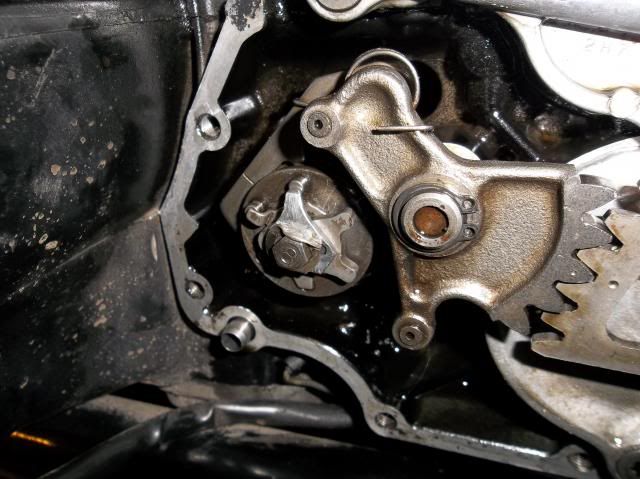
    If it doesn't work, it'll be loads of fun forming a stainless washer to fit over the long pins and clear the shift pawl pin boss, then notching it for the shift pawl pins.

    .

    Leave a comment:


  • trbig
    replied
    I have no idea why they made some of the pins longer. The only thing that touches those pins is the shift pawl in that slot. Where the pins protrude out further... nothing touches them out there, so why extend them out there with the funky washer?

    The main head-scratcher is trying to figure out a way to re-use that washer directly under the bolt head. It needs to somehow attach or lock in to the shift drum in some way, then still be bent up to lock in the bolt to help keep it from loosening. Maybe this is the purpose of that whole funky setup? For the other, I'd look for something a little beefier than a thin fender washer, but stainless is a good idea, even though it will be covered in oil for it's life. I'd try to match the thickness of what is currently there.
    Last edited by trbig; 07-18-2015, 10:45 AM.

    Leave a comment:


  • TomB
    replied
    Originally posted by trbig
    Absolutely disagree that the little shift pawl is going to have any influence on keeping the bike aligned in gear.
    You're right, the little pins won't keep the bike in gear, when in gear the selector quadrant sits back to central no where near the stops.

    The little pins are stops for the selector quadrant, it has riveted in stops top and bottom that hit the pins when the gear lever is worked.

    Leave a comment:


  • 3Phase
    replied
    I would love to get rid of that creepy starfish washer, it's just sitting on the shelf and I could swear it's trying to crawl off.

    I'll try to find a thin, stainless, fender washer to hold all of the pins in place under the 'crowfoot', then I'll grind two of the pins from the scrap engine and chuck 'em in my '80G when I get it back together.

    This ought to be interesting.

    .

    Leave a comment:


  • trbig
    replied
    Absolutely disagree that the little shift pawl is going to have any influence on keeping the bike aligned in gear. If that were the case, you'd constantly be getting bumped in the foot from the shifter on torque curves. The only case of this happening is when people try to hold it in gear from the 1st/2nd gear problem and that is when you bend pins and shift forks. The gears trying to separate causes the shift forks to move in the shift drum grooves, causing the shift drum to move. You've got a little bit of spring pressure on your shifter lever and that isn't going to hold anything anywhere. No amount of torque is going to move that shift drum anywhere from that detent pin unless the gears disengage somehow, causing the drum to try to move. If the pins were the guides, we'd never hit a false neutral.

    Take the shift pawl completely off and you still get the positive stops at every landing of the stopper plate. But, remove the stopper plate detent pin and it's never going to stop where it needs to be because of those pins. All those pins are is a push/pull spot to switch gears by pushing/pulling the shift drum to the next detent position.
    Last edited by trbig; 07-17-2015, 09:01 PM.

    Leave a comment:


  • 3Phase
    replied
    Excellent pictures, Tom! I agree, those two long pins and the 'crowfoot' are safety locks. I worked out what they did the first time I had to change the starfish washer (leaned against a handy barbed wire fence along the side of the road) but I couldn't remember exactly how it all worked without running through a few shifts.

    Tod, when 1st or 5th gear fights a shift or the drive train gets slammed there's 80 or 90HP to kick the shift out of the detent plate and the spring, it's just a post-shift assistant shift-fork positioner, not a lock.


    <sigh> That'll make three pieces on the end of the shift drum so I'm going to have to figure out a better way to fix it and carry it in the toolbag for the bike. I have no idea why Yamaha made it the way they did but "It's stupid but it works so it's not stupid."

    .

    Leave a comment:


  • TomB
    replied
    Originally posted by 3Phase
    Okay, I knocked the black widows out of a scrap '80G engine and got my hands greasy and black widow spiderwebby playing with the shift drum just for y'all. Eww!

    This may be a little difficult to follow because it for darn sure is a lot difficult to wrap my head around the events well enough to describe them clearly:

    I believe that the two long shift pins and the 'crowfoot' act as positive locking safety indexes for several of the shift drum positions to keep the drum from over-turning or kicking back.

    The shift pawl has an extra long 'throw' for 1st gear and 5th gear because there is no lower or higher 'next gear' pin available in the shift drum shift pattern.

    The two long pins keep the shift drum from rotating when 1st gear is first selected because they index with the lower shift pawl pin between them as the shift drum is turned to select 1st gear.

    The flat stamped 'crowfoot' that holds down the starfish washer does the same thing as the two long pins. It will index with the upper shift pawl pin between its 'toes' as the shift drum is turned to select 5th gear.

    As the shift pawl returns to its normal post-shift position, the shift pawl pin -- upper or lower depending upon the gear selected -- moves out of the index position and away from the two long pins or the 'crowfoot'.

    The starfish washer breaks as the transmission is shifted into 4th gear. For any of a number of reasons, the shift pawl pin boss hits the leg of the starfish washer that holds the 4th gear pin and eventually the leg breaks off.

    The transmission is shifted into 5th, the 4th gear pin vibrates out and voila! the transmission is stuck in 5th gear because the 4th gear pin is now trying to fall into the oil pan.

    I would leave the two long pins alone and figure out how to make a better starfish trap.

    .
    +1

    DO NOT grind down the longer pins!! they are the positive stops for the selector drum.

    If you can't get hold of an OE star plate make a separate extra plate to hold the pins in, make sure it doesn't foul the mechanism so the stops can work.

    Heres a write up I did about mine

    Leave a comment:


  • trbig
    replied
    I believe that the two long shift pins and the 'crowfoot' act as positive locking safety indexes for several of the shift drum positions to keep the drum from over-turning or kicking back.
    Those have nothing to do with that. On the other end of the shift drum, there's a star looking "Stopper plate" that a spring-loaded detent pin follows.


    The pins you speak of are just there to be pulled/pushed up or down. This overrides the detent pin which rides over the next hump on the stopper plate, stopping in the valley of the next notch and holding the shift drum in the proper position.

    So.. I'm sure the short guys in lab coats had a reason for the weird star washer and different length pins... but I sure have no clue why, nor why you couldn't use a complete washer to hold them in.

    P.S. This picture shows the circlip that came out of place, allowing the stopper plate to get cocked a bit sideways and let the detent pin fall off one side preventing me from shifting.

    Oops.. found a better picture of it.

    Last edited by trbig; 07-17-2015, 03:01 PM.

    Leave a comment:


  • 3Phase
    replied
    Okay, I knocked the black widows out of a scrap '80G engine and got my hands greasy and black widow spiderwebby playing with the shift drum just for y'all. Eww!

    This may be a little difficult to follow because it for darn sure is a lot difficult to wrap my head around the events well enough to describe them clearly:

    I believe that the two long shift pins and the 'crowfoot' act as positive locking safety indexes for several of the shift drum positions to keep the drum from over-turning or kicking back.

    The shift pawl has an extra long 'throw' for 1st gear and 5th gear because there is no lower or higher 'next gear' pin available in the shift drum shift pattern.

    The two long pins keep the shift drum from rotating when 1st gear is first selected because they index with the lower shift pawl pin between them as the shift drum is turned to select 1st gear.

    The flat stamped 'crowfoot' that holds down the starfish washer does the same thing as the two long pins. It will index with the upper shift pawl pin between its 'toes' as the shift drum is turned to select 5th gear.

    As the shift pawl returns to its normal post-shift position, the shift pawl pin -- upper or lower depending upon the gear selected -- moves out of the index position and away from the two long pins or the 'crowfoot'.

    The starfish washer breaks as the transmission is shifted into 4th gear. For any of a number of reasons, the shift pawl pin boss hits the leg of the starfish washer that holds the 4th gear pin and eventually the leg breaks off.

    The transmission is shifted into 5th, the 4th gear pin vibrates out and voila! the transmission is stuck in 5th gear because the 4th gear pin is now trying to fall into the oil pan.

    I would leave the two long pins alone and figure out how to make a better starfish trap.

    .

    Leave a comment:


  • bikerphil
    replied
    I don't see any reason why it wouldn't work TC. Perhaps I'll tackle this in the near future, I have an extra shift drum.

    Leave a comment:


  • TopCatGr58
    replied
    Hey Phil,

    Scott/3Phase has been rather busy with other projects and so hasn't been able to "look" at his spare parts or do any cipherin' on it!

    You being a real bike mech, what do you think about what I suggested, the grinding off of the longer pins and just throw a good thick flat washer on it...with the appropriate alignment hole drilled into it of course!

    T.C.

    Leave a comment:


  • bikerphil
    replied
    The washer bent/pin fell out
    I think he is referring to the star washer that holds the pins in on the shift drum under the left side shifter cover, which is NLA. People have been talking about grinding down the longer pins and just using a flat washer instead, I don't think anyone has done it yet.

    Leave a comment:

Working...