
When I was in rehab for a low back injury I was instructed to set up working surfaces like this. It has worked well for me.
While standing in a comfortable stance with elbows bent so your arms are parallel to the ground, measure from the elbow to the ground and subtract 2 to 3 inches. That will work out to be a good working height for your bench top. Much lower then that and your low back will get sore. Much higher and you will be hitting your elbows on the bench. My bench is 37.5 inches high. My elbows are 42 inches off the floor when my arms are bent as described. It's not about how tall you are, it's how high off the floor your elbows are.
Rob
-
Put the bench together tonight, lookin good! Will have pictures tomorrow when I finish up the shelf underneath. Its definitely stout, not going to have a problem in that area.
Leave a comment:
-
Bench height should be tailored to the individual. You should be able to work comfortably while standing without bending your back, and without overstretching to get to the other side. Set up some boards on some drums or similar and experiment to get a height your comfortable with.Leave a comment:
-
-
Navel high or thereabout is a good general rule of thumb for a stand at bench, or about the same height as the "workbench" at the local watering hole
Leave a comment:
-
Can cut top out of a sheet of medium density material. Smooth and takes a beating and will last well. Your local Home Depot o such will have this material.Leave a comment:
-
Had a cheap ipod radio but that died, now I use my.phone and Pandora radio.Leave a comment:
-
Don't use aluminum, as it gouges rather easily (the first time you cut yourself wiping the counter, you'll know what I mean..). If you want to use metal, get some 16 gauge or preferably thicker galvanized steel. Thinner than that, it dents too easily and you'll end up with a lumpy countertop. Hardboard ('Masonite') works well, is pretty cheap, and easy to cut. Glue it down with some contact cement or use counter-sunk screws for a long-wearing surface.
Audio? Who can hear over the grinder/drill press/welder/lathe/compressor? One of these days I'll pick up some used speakers that can take the power of the 200 WPC Crown amp I have in a closet, but until then the tools workin' are music to my ears...
Leave a comment:
-
Thanks for the thoughts! The plywood Im using is oak, not crappy pine... Something thicker would be ideal but I doubt anything Im working on urls going to be crashing through it. I was considering putting some aluminum down to cover the surface, its just not in the budget right now. I think Im going to put the height at waist high and call it good. I also have a piece of countertop Im going to put on the end at a lower height. That way if Im working on something sloppy I can just wipe it up... Im excited to have a bench, building it is half the fun too!
My next question is, what are you using for audio in your shop?
Last edited by WMarshy; 04-22-2011, 10:00 AM.Leave a comment:
-
Workbench?
This one works great. It's got adjustable legs for height. It's portable so you can take where the work is instead of bringing the work to the bench. If you need more work space, you can just get another one. When your work is done, you can fold it up and put it out of the way!

YesI'm trying to convince myself how well I have it.

BobLeave a comment:
-
I'm 6' too, and I know what you mean about low counters...
It depends on how you're planning on using the bench. If you're only going to do 'light' work or work on small items, a higher bench is OK. But if you want to do 'heavy' work, don't go too high; if you're trying to grunt something heavy up onto or off of it, the extra height isn't a help. I like the top just above my belt buckle. And if you're going to mount a vice or bench grinder, the extra counter height can put those too high. If you're doing any grinding/drilling, the extra height just puts that stuff closer to eye level and that's not always good.
Make your countertop as stout as you can afford. While the base framing is important, if you do any beating on 'stuff' that will transmit the blows better. Using 1" plywood, I'd double it to 2". I'd also put some 1/4" hardboard over the top of the plywood as it will wear better and clean much easier. Use the extra hardboard to put a 4-6" backboard on the sides of the bench that go against the wall so you don't lose stuff in the gaps, and that will also help keep any spills on the bench. Slap a coat of some sort of sealer on the countertop as that will help it from soaking up the inevitable spills/fluids. Yeah, it'll get worn off in places, but it still helps.
I've got mine at 38", and that's about perfect for me. I certainly wouldn't go over 40". I was lucky, I salvaged commercial-grade all-metal cabinet bases for mine, and my benchtop is made of 1.5" solid-core hardwood doors (also salvaged). It'll support anything I can manage to get up there...Leave a comment:
-
Mine is 34" tall. I'm 5'10", and it's perfect for standing work. I dropped one end on it to allow the top of the bench to be a guide table for my mitre saw. All 2X4 contstruction, with 2X12's on the top. I trimmed the sides of the 2X12's so they would meet flat against each other (a poor-man's jointery). The feet are 3/8" bolts held into the bottom of each leg with Tee nuts, allowing me to level the bench. I mortised/tennoned the 2X4's to frame the bench, and mortised in a piece of plywood on the ends to keep things from falling out the end. The only fasteners I used are glue and drywall screws.
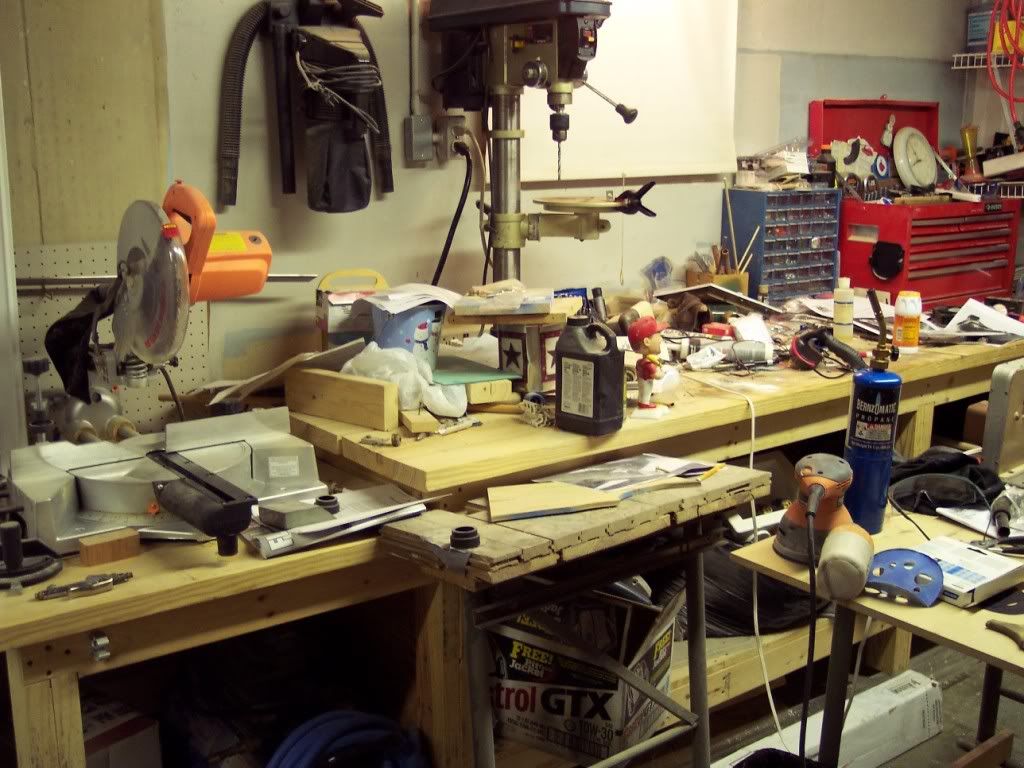
Leave a comment:
-
What did you use for the top? My frame is 2x4 frame except 4/4 corner posts and Im using 1" plywood for the top with 2x4 16" OC. Just using 3" screws for fastners.
Good idea with the air line, I'll keep that in mind when I get a compressor.Last edited by WMarshy; 04-22-2011, 07:04 AM.Leave a comment:


Leave a comment: