
Space/Time
Amazingly, after much rocket scientific calculations, I have arrived at the same conclusion Greg.
-
You know it all depends on your view of things and getting in sync reduces IBJ To get a good view of things your distractions need to be removed and being out of sync defiantly creates distraction. This little exercise shows how much IBJ can easily skew some peoples perspective even to the point of SB syndrome. I get in sync and try not to worry about what I see when IBJ causes SB syndrome.
Leave a comment:
-
Here is the bike last night with a bad sync:
75mph @ 5k.
Good sync., it reads 80mph @ 5k.Leave a comment:
-
IDM, I think you're missing the point. If you could peddle the crank it would still require the same rpms on the crank to reach the same rpm at the back wheel. It's a gear train. But the gauges that measure the mph's and rpm's are much more suspect in terms of changes.
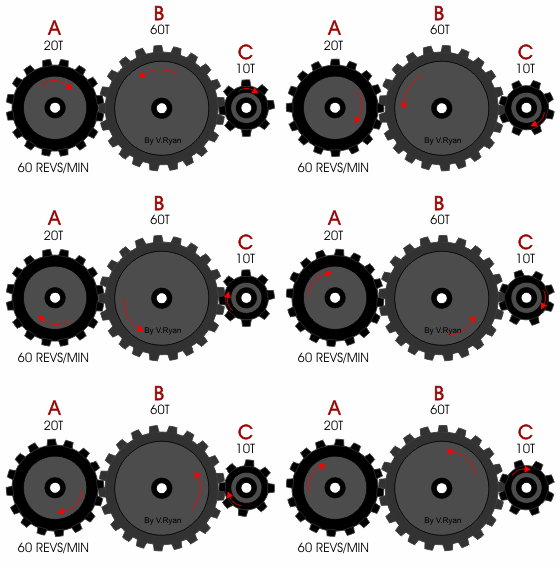
Look at it like this - no matter how much power is applied to "A", "C" will always be turning at 120 rpms when "A" is at 60 rpms.
Leave a comment:
-
Well, if anybody is willing to back me up and confirm my observation . . .
Somebody please take their carbs out of sync., and observe the rpm vs. speed. On my part, I will record my bike in it's current state (bad tune), and re-tune the carbs early tomorrow morning and check the difference. Give me a day or two.Leave a comment:
-
-
It's my observation only. If you're stating it's some act of God causing my rpm's to be higher in-relation to a poor sync., then so be it. However, I don't believe in coincidences, and I don't think that it's a coincidence that my rpm's rise with a bad sync., and lower with a good sync . . .Leave a comment:
-
-
-
Well, now, let's not forget that the crankshaft spinning and working through a series of gears to a spinning rear wheel is pretty much a fixed mechanical link. And remember also that the tach is getting its electrical signal via some sort of electrickery voodoo magic and translating that into a mechanical motion of the tach needle. Lastly, and maybe most critically, the speedometer is getting its input from the front wheel via a springy cable whirling within an outer cable, which spins some magnets inside a metal cup, which mechanically drives the speedo indicator needle.
Oh, and don't get me started on how the circumference of the front wheel changes ever so slightly with changes in pressure and air temperature, and location of the riders's butt in relation to the center of gravity of the bike. As the circumference increases, the wheel spins fewer times for any given distance, which has a direct result on the speedometer indication.
It's a wonder that any of this ever works the same twice! Last edited by Ken Talbot; 09-21-2015, 11:13 AM.
Leave a comment:
-
And one other thing as it relates to clutch slippage. Higher torque is what makes a clutch slip - not lower. So if the clutch is slipping you would expect it to slip more with higher torque which would yield higher engine rpms.Last edited by dbeardslee; 09-21-2015, 10:16 AM.Leave a comment:
-
Again, the gearing determines the rpm at a given speed. It doesn't have anything to do with the power the engine is putting out. If the crank makes a revolution there's a mathematical relationship that determines how far the rear wheel will turn. The gears don't change the number of teeth they have based on power. There's only one thing in there that can change, as BA80 alluded to, and that's the clutch. Other than that it's a straight gearing relationship.
XS11 tachs have been known to get flakey, and I think you're putting your faith in the wrong part. If you really want to know what's going on use an auxiliary tachometer with sufficient reliability and resolution and see what that tells you.Leave a comment:
-
It does that because when the engine is out of tune it throws a wrinkle into the time space continuum that causes the STEEL crankshaft to turn slower than the STEEL main shaft because flux capacitor that connects them becomes distorted and can't operate at warp speed.
Nanu nanu
Simple
Leave a comment:
-
Everything you say is true, and makes sense. Engine speed(RPM), and actual speed (MPH)are correlated, so depending on your tune you are either efficient or inefficient(hens higher RPM to achieve the same result = 80 MPH)Leave a comment:


Leave a comment: