
 .......ain't rocket science.......BTW, find the missin' smoke yet?
 .
. .
.
-
-
-
Glad to hear your finally in agreement with that 'straw' function......now I just gotta' work on the '2mm give or take' thing........the 'give or take' just ain't gonna cut it  .
.
Leave a comment:
-
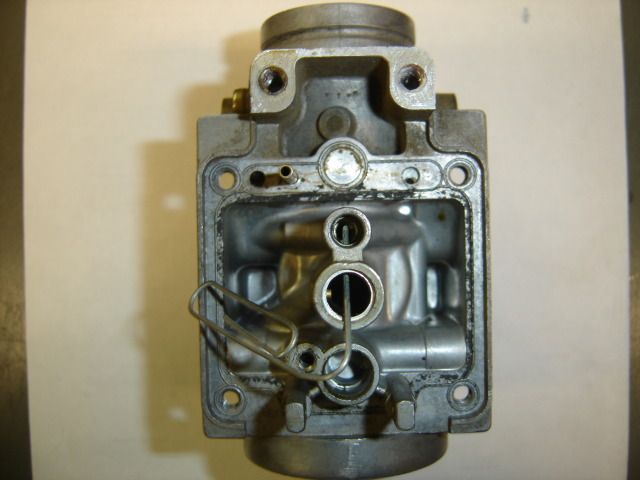
For those that have a crossover in your carbs:
Here's a pic showing the crossover:
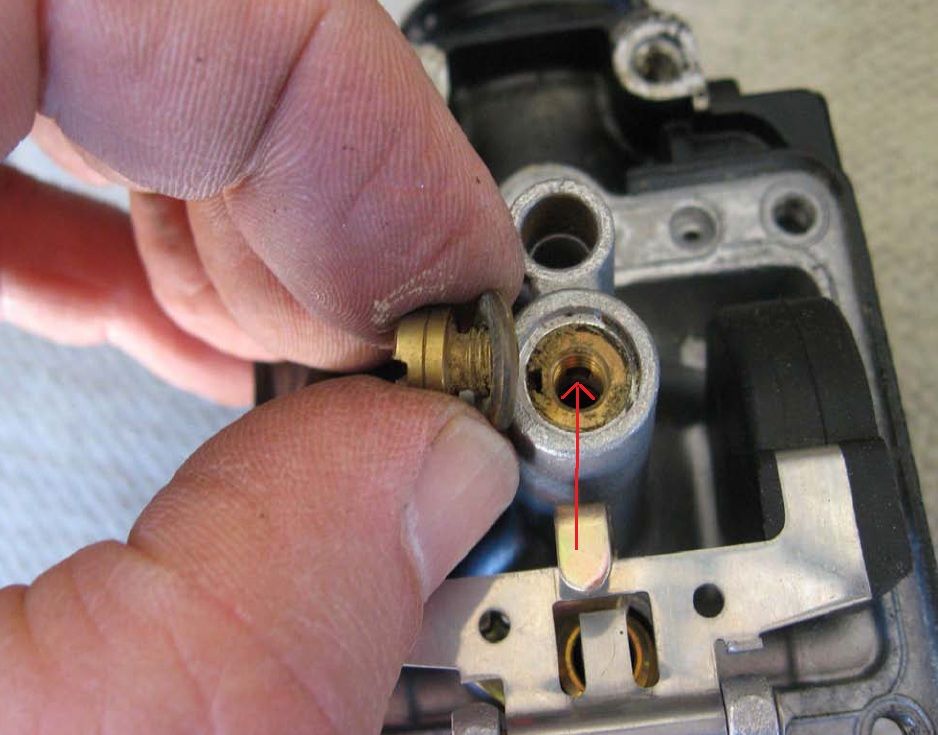
Here's a pic of the emulsion tube(s): (most of us have the middle one)

If you look where the red arrow is you can see a hole in the side of the bottom of the tube and this is where the fuel for the crossover goes thru.
What I'm trying to figure out is this: Does the pilot circuit get enough fuel flow thru the crossover if it has to go thru the main jet first?
Maybe because the pilot jet metering orfice is way smaller than the main jet orfice, therefore, it couldn't suck more than what the pilot jet orfice will allow.
The other thing I'd like to point out is the nominal fuel level is just a few MM's below the gasket/carb lip/rim.
Thanks to TC, I cropped one of his pics and drew in an imaginary level of fuel which should be about correct. (give or take a mm or 2)
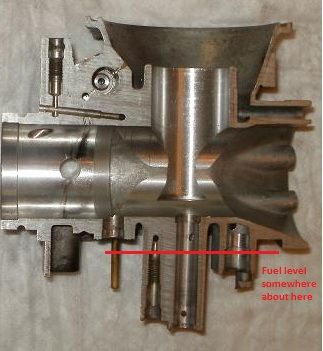
Using this as a visual aid, and knowing that our carbs use vacuum to draw fuel up to the carb throat, you can easily see that if your fuel height is too low then it would run lean because it's 'harder' for the carb to draw up the fuel. Conversly, if the fuel level is too high, then too much fuel would get sucked up and it would be too rich.
Now that I've figured all this out, It's time for me to pull the carbs off Hugo and check the fuel heights. (Note: Hugo has the crossover)
I pull the plugs this past weekend and they were almost ghostly white/grey and he doesn't hardly pull in 4th gear at 65mph like Scarlet does.Leave a comment:
-
Excellent job TC!
So the question for me would be. When cleaning carbs by any common method how does one confirm with any confidence that ALL the internal galleries have been fully cleaned and are cleaned to the factory intended diameters. As I saw with my own carb issue that is still not completely solved, clean isn't good enough, clean and of the correct diameter is a key issue in these carbs. The carbs I was working with had been cleaned by hand after soaking in carb cleaner, sprayed out with carb cleaner and put through the ultra sonic cleaner and in the end, it still wasn't good enough. So now I will pull them again and attempt to clean them completely but HOW to do it and be sure the job is in deed complete becomes a question.
RobLeave a comment:
-
Hey Folks,
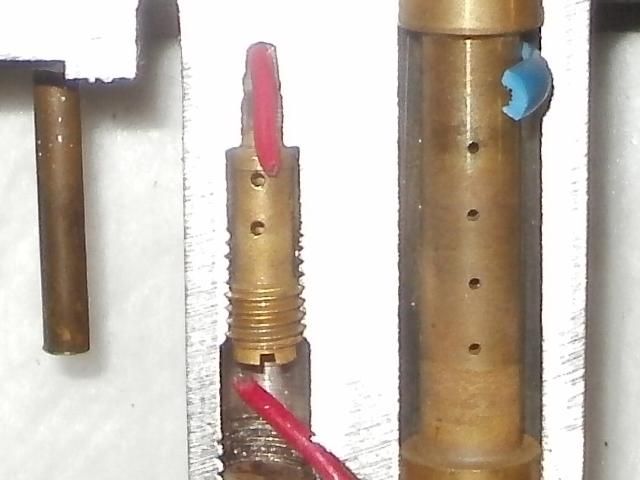
A little slow posting this, but this is a zoomed in view of the pilot jet in it's tower. As Mack said, the jet is seated flush against the TIP of the jet, note that there are still plenty of threads in the carb body well beyond the location of the jets threads which shows that the jet just keeps threading in until if bottoms out against the carb body down in that tower. And just behind that RED piece I used to show fuel flow is the Aeration port coming from the other side of the carb body.
T.C.Leave a comment:
-
Pilot
From the second photo TC did with the jet in place, it certainly looks like the jet's nose seats and seals the chamber. Looks like the pilot air enters farther up to the right and goes straight up providing an drawing action.Leave a comment:
-
Airing up the well
I don't have any Pilot Fuel jets handy to check so I'll have to dig up a fuel jet and check the witness marks.
I looked at the picture of the Pilot Fuel well at 400% but I can't tell if the chamfered and metered tip of the fuel jet actually seals off the bottom of the well.
78_79 Sliced Cross 02
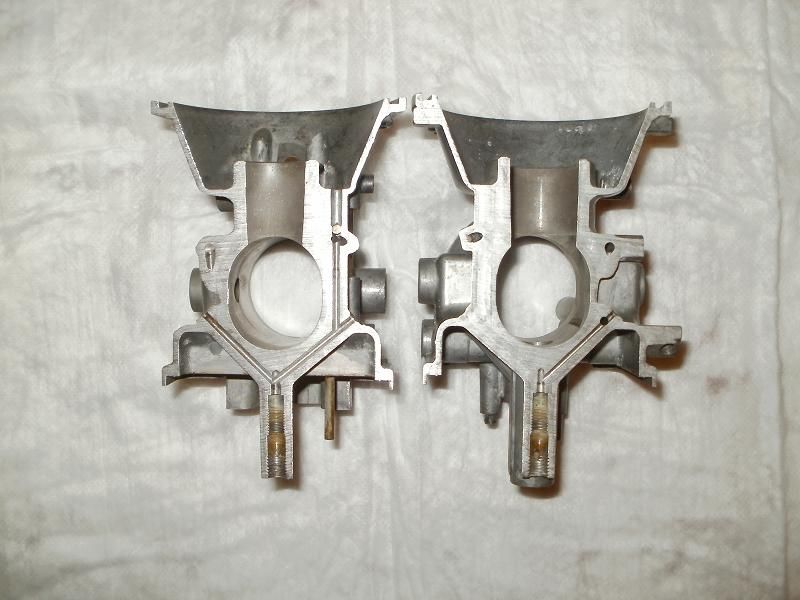
It looks like the shoulder of the jet seats in the well. The shoulder would be the chamfer next to the threaded part of the jet by the screwdriver slot. If the tip of the jet doesn't seat and seal the well, the Pilot Air could go around the tip of the jet, into the well and through the air bleed holes.
.Leave a comment:
-
I remember the thread. Back then I wasn't as convinced as I am now that holes vs. no holes made no difference. After seeing TC's slices through the carbs I am convinced. Geez, you would think I am from Misouri (show me state)!Leave a comment:
-
Here's my thread on the pilot jets.
Leave a comment:
-
While i was researching this a while back, i noticed that the older xs650 (74-78era) carbs had a air supply that fed the side where the holes were. So the carbs evolved but they used the jets that were already out there.
Some time later, yammy changed the part number for the 42.5 jet.
I'll see if i can find my old thread. Standby...Leave a comment:
-
-
Amazing! I always thought there was an air bleed to the side holes of the pilot jets. So why did Micuni design the pilot jets with side holes ??Leave a comment:




Leave a comment: