-
I was told how to correctly re-harden the dogs, but you would either have to have a machinist do the gear grind so everything was EXACT, or put the gears back in after grinding and run them a short while so they seat together, then remove them again and harden.
If the gears are not case hardened, as you both say, why are gears that have run thousands upon thousands of miles still in pretty much their original shape, yet after grinding, and run just a couple thousand miles, the dogs AND slots are smashed and misshapen to such an extreme? Your theories don't hold up to real life experience. -
You will always find a level of work hardening on the surface of high mileage gear teeth and their dogs that give the appearance of case hardening.
I've done the dremel and washer fix and many other gear grinding jobs professionally and agree with Senrak, the gears look through hardened (better described as toughened as they're not that hard). I found the same on Suzuki gears. Old Triumphs on the other hand are case hardened and are very noticeable when ground, they give off yellow sparks turning very orange as you hit the softer inner metal, the case hardened gears can easily be re-case hardened when machining is complete, if you feel the need to case harden your Yamaha gears have a go, you'll probably end up making them softer in the process
Brinell hardness testing uses a ball bearing pushed into the metal at a fixed load, the diameter of the indent measured to tell hardness. I always use Rockwell C scale standard which uses a small pyramid in a similar manor, across the corners of the square indent measured, generally for harder metals than the Brinell test. Any Toolmaker will have done this stuff.Leave a comment:
-
I don't have a hardness tester either, but I've done enough of these that I know there's a difference in the surface steel when you start grinding and the softer steel underneath. I use a carbide bit to do mine. When you start, there's not much progress, but just under the surface, it'll eat that metal in a hurry if you aren't careful.
TC, I don't know if others have said it, but I have said that after grinding, the gears and slots are just smeared blobs of metal mashed together. I rebuilt an engine once and did the gear grind. That motor only lasted 2500 miles, so I went back in and saw what was happening to the gears after the grinding them and running them. Back-cutting them is useless. The dogs/slots just smash together flat anyway, and all you've done by back-cutting is remove even more material. If you doubt the case hardness statement, look at a set of gears run for thousands of miles, then look at a set run just a couple thousand after grinding.Leave a comment:
-
Well your info on the gears would be good news to us, knowing that the hardening is throughout and not just surface. The gears have a dark patina on their outsides, that turns to a lighter metallic grey once we have done a bit of grinding on them.
What do you mean you don't have a BRINNELL hardness tester?? You were supposed to have gotten that with your retirement package!

I thought I had read/heard about someone who had done the gear grinding and then later opened it back up and had seen some prominent smashing of the dogs where they interface with the slots!? However prior to grinding on them we just see the rounding off of the interface edges.
Yes, the formation of the angles are the important parts of the grinding to help the gears PULL together vs. trying to slide/push apart under stress. The recommended washer swap is to just help the 2nd gear engage more of the dogs/slots together, since 1st and 2nd are under more frequent stress from being shifted thru much more often than the higher gears.
T.C.Leave a comment:
-
Reply to post 12, DUHHHHH I threw the bolt from the shift lever in that bin while I was testing the shifting using the foot shift lever. Sorry ! Please excuse me !
Done };~)Leave a comment:
-
Okay, I did the grinding. As I look at the postings here and study the gears in my tranny a couple things come to mind. I retired from a large gear drive manufacturer and in my years there I saw many methods used to harden steel gear castings like these. These appear to be through hardened with the machining done after heat treatment of the gear blank. I don't have a Brinnell hardness tester, but the hardness of these gears does not appear to be very high. They don't really show any signs of being case hardened or flame hardened after machining, one of mine even showed signs of a less then perfect deburring job. So, I am skeptical about the case hardening claim in this case. If you can prove me wrong, please do so.
The other thing that stands out is the angle of the grinding and the mechanical advantage it gives. As has been mentioned here, the dogs on the middle gear, (third or fourth) are certainly produced with an angle on the dog. Makes me think that that angle is the most important part of the process.
Just some observations. Time will tell if my work is successful in solving the skipping problem.
By the way, I need to thank all the participants on this forum, your input is extremely valuable.Leave a comment:
-
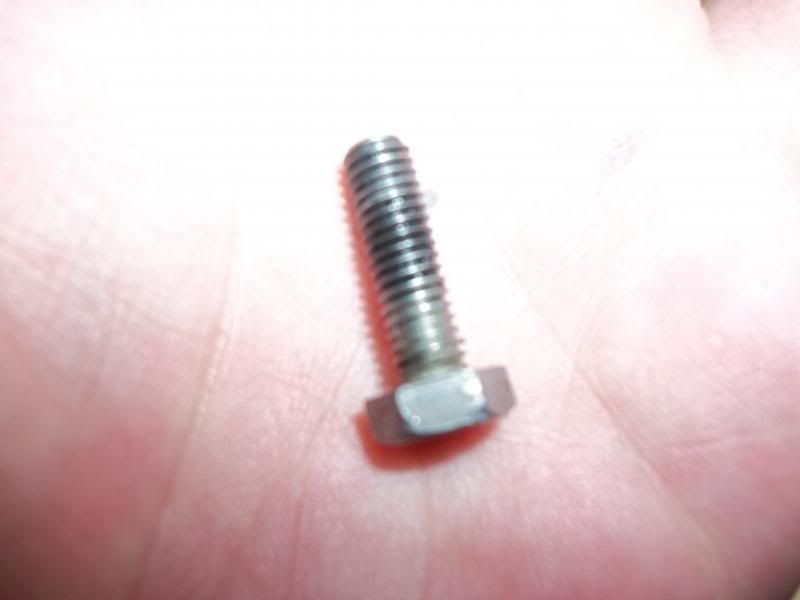
odd bolt in the oil pump parts can
Don't mean to hi-jack this thread but thought since you were just in there maybe you would be able to tell me where this bolt goes, last bit in the oil pump gear cluster parts pan.
By the way I checked the lock up on 2nd gear and all but about 3/16 of the dogs come through the slots with the washer swap, a little space at the bottom/inside, maybe 1/64 ", seems good ! Hope they will wear/mash together ! Did the dogs and slots leaving as much as I could of the hardened edges.
Good luck on yours ! Done };~)Last edited by donebysunday; 09-17-2013, 05:36 PM.Leave a comment:
-
I have done both, multiple times. I work on my own and others bikes locally. What I see in your pics shows a bike that has been skipping. The shiny part between the slots is bound to be there, as the gear will slide across there to drop into the slot when all is working well. However, the rounded lip on the 2nd gear slots, and the amount of rounding on the leading edge of the 5th gear dogs are telling that it has been skipping.
I am with TC, do it now to avoid pulling those things out a second time. And do move the washer. I can speak from experience that if you do not grind the 5th wheel dogs close to a sharp edge, you very well may be back in for a second go at it.
 That is with the washer swap. Only happened once...never again.
Leave a comment:
-
-
-
Dremel
Please, only responses from those who have done the Dremel AND moved the washer. Have you had any bad or odd effects from the washer? Such as different or hard shifting, or leading to some other gear starting to slip?
ExcessiveBiker
81 SHLeave a comment:
-
Well, I guess I'm in the minority again of the grind-happies. If it doesn't skip in 2nd now, and you swap the washer on 2nd, it never will. AND you'll still have the case hardening on your gears.Leave a comment:
-
Almost looks like mine !
Don't forget to move the washer !
Wish I could show you but just put it back together just a slight angle and match the dogs to the slots.
My 1st gear was fine too.
Take as little off as you can !
Should have my SH ready to try in a few days to couple of weeks depending ?
Best of Luck !
Done };~)Last edited by donebysunday; 09-16-2013, 08:06 PM.Leave a comment:


Leave a comment: