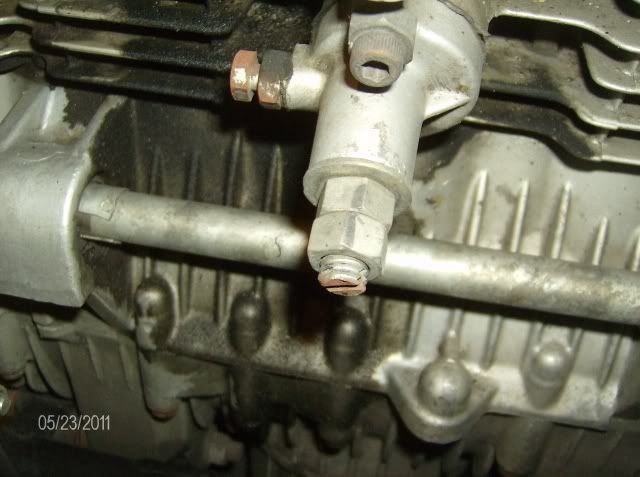
Cam Chain adjustment...

Collapse
X
 
  • Time
  • Show
Clear All
new posts

  • ViperRon
    replied
    My 2 cents

    A tip I got some years back may help a little with the slip issue on the original tensioner assembly. After tightening the lock screw a few times it can cut groves in the flat spot that the lock down comes in contact with. After this surface has several spots in it it has a tendency to first of all hang in a previous location not fully taking slack out of chain and second tightening down on a damaged hump not getting a full grip on the shaft. All this is intensified by someone not using a torque wrench and too much torque. Not having a tight chain it tends to have more vibration on an already weak piece of metal and can loosen up much easier.

    The cure is take out the shaft and use a fine flat file to create a smooth surface in the flat spot for the lock down to tighten against. Also make sure and remove any ruff spots from the sides caused by the file so the shaft does not stick. The end of the screw should be checked also as some can have a bur that will tend to cut in and in rotation actually move the tensioner plunger out of adjustment. Remember if you remove too much metal then you create a weak spot which can cause the mechanism to flex and or bend and that can cause adjustment problems also.

    I feel the best fix is the auto tensioner once you have a damaged original tensioner.

    Leave a comment:


  • oldnortonrider
    replied
    Automatic CCT ratchet pawl slip

    Originally posted by 3Phase
    Howard, unless you have an aftermarket (APE) tensioner or a home-made tensioner like Phil's, dynamic adjustment will never match static adjustment. If I was paying for the work I'd find another shop. Pronto. And I'd staple that mechanic's handwritten note to his boss' door while my money and I were running out of it.

    There are some non-interference engines that might be safely adjusted while they're running at idle but adjusting an interference engine like the XS or XJ with its O.E.M. tensioner is a great way to stock up on spare parts for the next engine.

    FWIW Roo (bobber) stopped by this afternoon with a freshly picked V-Max tensioner and I helped him install it with a new hand-cut gasket in less time than it took for him to brew a hot cup of tea. After a bit of spirited riding it's working fine with no noise, no leaks, and no drama.

    That said, I'm still not entirely satisfied with the automatic tensioner. I'll be adding safety wire to the one on my bike so the spring retainer nut can't vibrate loose and fall out. I'll also remove the spring guide pin from the inside of the nut so I can drill and tap the center for a long bolt with a lock nut to backstop the tensioner piston. The spring will still be able to automatically push the piston out of its housing and keep tension on the timing chain but the timing chain won't be able to knock the piston back into its housing if the ratchet pawl slips or breaks.
    In 1986 I bought a new Kawasaki Concours; in 1988 I sold it to my secretary~~she bought it for her boy friend, who also worked for me, and was a fairly accomplished motorcyclist and mechanic. I sold it cuz I had bought a new 1989 VMax. The Concours was in fairly mint condition with about 5000 miles on it when I sold it to the folks; they went everywhere; he "hot-rodded" it pretty strong, but did maintain it fairly well. In 1990 they went to Sturgis on it; on the way back, coming around thru Colorado, the CCT ratchet pawl must have failed. Long story short~~they caught a bus home, took his pickup to Colorado, loaded the Concours and brought it back to Arkansas. I got the story about a year after the incident from the guy; story was that when the CCT gave out, engine had a lot of "racket"~~he didn't really want to tear into it on the road, and at the time he was not sure "what to look for". I think they did luck out~~no valve damage~~and got by with replacing the CCT.

    Leave a comment:


  • 3Phase
    replied
    Howard, unless you have an aftermarket (APE) tensioner or a home-made tensioner like Phil's, dynamic adjustment will never match static adjustment. If I was paying for the work I'd find another shop. Pronto. And I'd staple that mechanic's handwritten note to his boss' door while my money and I were running out of it.

    There are some non-interference engines that might be safely adjusted while they're running at idle but adjusting an interference engine like the XS or XJ with its O.E.M. tensioner is a great way to stock up on spare parts for the next engine.

    FWIW Roo (bobber) stopped by this afternoon with a freshly picked V-Max tensioner and I helped him install it with a new hand-cut gasket in less time than it took for him to brew a hot cup of tea. After a bit of spirited riding it's working fine with no noise, no leaks, and no drama.

    That said, I'm still not entirely satisfied with the automatic tensioner. I'll be adding safety wire to the one on my bike so the spring retainer nut can't vibrate loose and fall out. I'll also remove the spring guide pin from the inside of the nut so I can drill and tap the center for a long bolt with a lock nut to backstop the tensioner piston. The spring will still be able to automatically push the piston out of its housing and keep tension on the timing chain but the timing chain won't be able to knock the piston back into its housing if the ratchet pawl slips or breaks.

    Leave a comment:


  • XS1100_OEM4ME
    replied
    Gaskets

    Just kidding around, i have got picked on for saying, just buy the gasket, from so many who say, RTV is all you need

    Originally posted by bikerphil
    Yes Rasputin good tip, when removing the tensioner, ALWAYS have the bike on the centerstand and/or level. I have learned that the hard way.

    OEM, it doesn't leak anymore, I used RTV in the defunct side lock down bolt.

    Leave a comment:


  • bikerphil
    replied
    Yes Rasputin good tip, when removing the tensioner, ALWAYS have the bike on the centerstand and/or level. I have learned that the hard way.

    OEM, it doesn't leak anymore, I used RTV in the defunct side lock down bolt.
    Last edited by bikerphil; 12-30-2011, 11:27 PM.

    Leave a comment:


  • Rasputin
    replied
    Originally posted by James England
    It isn't really a downside though. It's only two allen bolts to remove the complete CCT. I just did my shims and took the tensioner completely out in less than 60 seconds.
    Some have shown that removing the CCT can end up with the chain off its sprockets. Mostly due to doing it improperly or on its side stand. As you say what is the downside, but to an lesser informed person than yourself there may be issues. I worry so much about my valve train that I am over cautious about what and how I do it but others get a "Git er dun" attitude.
    It is a definite downside for the uniformed and more reckless of our members

    Leave a comment:


  • XS1100_OEM4ME
    replied
    Gaskets

    Gaskets instead of RTV

    Originally posted by bikerphil
    I have no problem adjusting my modified stock tensioner with the engine running, now if I can only get it to stop leaking

    Leave a comment:


  • Bonz
    replied
    Checked the valves right after putting 1025 miles on the bike in 3 days for the Colorado Rally in July. The cam chain was nice and tight, I checked it, not knowing that knowledge would come in handy at this point, but it was a sweet looking cam chain, as well there was not a spec of varnish or anything in the valve train or on the valve cover. So, by all counts this method of adjusting doesn't seem to compromise cam chain tension one bit. I would think, to my mind, doing the cam chain tension at idle would get it as tight as it could get.

    Maybe that's why this bike is doing so well valve-train wise compared to bikes that are talked about as having worn chains with the standard adjustment performed, the cam chain is adjusted better/tighter. I'm just under 20,000 original miles for what it's worth. And oil changes with 15w-40 every 2000-2500 miles, filter every other change.

    CaptonZap could chime in if he's around, he was there assisting in the adjustment. He just keeps shaking his head each time we dig into any part of my bike "It just shouldn't be this CLEAN or tight" is what he mutters...

    I don't think the valves had been checked or adjusted since early in the bike's life, so the fact all exhaust valves were in the middle of spec, and the intakes were all on the min side of spec (but no room to go lower) I'd say it's a mighty healthy valvetrain on the whole. Adjusted all the intakes to the middle of spec and should be good for a while to come.

    I'm a fortunate guy to have picked up this bike in the shape it was in 3.5 years ago, and for what it's worth have not had any in-line 4 cyl engine that was as smooth as this one, not even close (Bandit 1200, ZRX 1200). A carb sync in Sept 2010 was the final touch, and it's one smooth runner.

    Leave a comment:


  • bikerphil
    replied
    I have no problem adjusting my modified stock tensioner with the engine running, now if I can only get it to stop leaking

    Leave a comment:


  • TopCatGr58
    replied
    Rotating photo

    Yeah, I, too, see the thumbnail as properly turned, but the original photo is still on it's side! It would be a bit more work, but you could edit/rotate it in your computer's photo editting program...even Windows Paint will do it, then delete the original on photobucket, and then reupload the photo with the same NAME, and it should Re-Link just fine and will be properly turned!

    Guess the next time YOU need to adjust or check your valve shim/lash, you could perform the adjustment idling adjustment first. Then pull the cam cover, and check how much actual slack you could pull up between the cams. Then perform the STATIC adjustment, and recheck the slack to see if you get more or less, and then you/we'll know if it's better or equivical, or not as good!

    T.C.

    Leave a comment:


  • Bonz
    replied
    Crap! Dang picture is rotated in my photobucket account but won't transfer as rotated. Sorry for the undue neck tension in craning to see it...

    Leave a comment:


  • Bonz
    replied
    Try this again...


    Thanks for all the discussion.

    If you are concerned about what "might" happen, then don't do it. However, it does not mean (as discussed and verbalized here) one way over the other is better in terms of the outcome, which is a properly tensioned cam chain.

    With that said, is it mechanically possible for a cam chain adjusted with the method I've talked about to be more properly tensioned than using the static method?

    Just askin'...

    Leave a comment:


  • Bonz
    replied
    Thought it had rotated... Dang user error...

    Leave a comment:


  • TopCatGr58
    replied
    Ouch, got a crick in my neck reading it!

    Thanks Howard,

    Next time perhaps you'll rotate the image before uploading it!

    Well, back in the "day" as well as now, time was money, and saving minutes doing maintanence might have paid off for the shop that he worked in, being able to possibly add/do one more 30 minute job after doing a few of these "quick" CCT adjustments?!

    Glad it's been working for you, hope it continues to do so. YMMV to others that might consider this versus the manual/by the book procedure.

    T.C.

    Leave a comment:


  • Bonz
    replied
    Try this...

    Handwritten in the good old days, stapled over the factory manual page that shows the "standard" way to do this.

    Leave a comment:

Working...