-
Ok Mr. Microphone Man
In anticipation of what I think my next problem will be, is it possible to get inside an OEM solenoid?
As mentioned earlier I did a test on the solenoid by removing the starter cable. Then I read the voltage of the battery with key off. Then I placed my volt meter across the negative terminal of the battery and the starter side of the solenoid. I turned the key on and pressed the starter button and read the voltage again. I don't remember the voltage at each point, but I do remembe that I lost 3v to 3.5v.
Is that a normal drop in voltage?Leave a comment:
-
Charge Ahead!!
Narrator Voice-Over:
"Meanwhile as Mashermoto's new battery is being charged/prepared for installation the XS11.Com Virtual pit crew loses interest. After all they see it about as appealing as watching paint dry or watching the grass grow. Their attention and discussion wanders...."
Odd thing about batteries is that those CCA ratings of whatever amperage come into play not only when the starting system is engaged but also when a dead short is made across the battery terminals. (Or when the good battery is immediately connected to a "bad" one.)
Another battery rating comes into play when jumping one battery to another which is independent of the charging system voltages/current. It's called the battery "BULK" rating or something equally off-putting. It's the amount of current that a battery can safely accept without being damaged when the battery is at it's lowest voltage/minimum capacity level. I mean a "near-death" level. The rating is there in the data sheet for all to view.
This bulk rating is higher than the "acceptance" rating which is what we generally see when we hook up a 10-15-20 amp charger and look at the needle after 10 minutes. But even those chargers which are so big that they have to be rolled around on wheels have safety features which limit the current to below the usual sized car battery "bulk" rating.
So....connecting one fully charged battery to one at or near DEATH is a very risky action. The moment of connection is a pass/fail test where without any safety devices inline the donor battery graciously offers it's maximum CCA and the recipient battery may/may not gulp down more than it's safely rated to swallow in one big Bulk swallow. If all goes well nothing happens. If not I can tell you from personal observation that the results are both LOUD and messy.
Given this and the possibility of polarity problems due to misinformation, poor observation skills, or hop-induced bravado, I really wish that the cable manufacturers would make a set which let the operator make the connections at each vehicle and then move somewhere away from the batteries where one could join a connector in the middle of the cable. That's just my own personal comfort zone.
BTW, According to the measurements I took last night the actual resistance of my starter circuit was between .0365 and .04 Ohms. (Voltage drop of 3 volts@ 80 amps measured at the starter side of the solenoid...) Not really useful to know cause that resistance is too low to read on any of the meters I own. Point is that when the starter/solenoid/cables are connected to the battery it's not a total dead short. Still makes the battery put out a decent amount of it's CCA rating though.
Video was uploaded to photobucket just like an ordinary pic. Inserting in forum post was same method as posting a pic as well.
We now resume the standard "sitting on pins and needles" as we wait for Mashermoto's next update....
.
Last edited by Larrym; 02-23-2010, 05:55 PM.Leave a comment:
-
79,
No problemo on the charge.
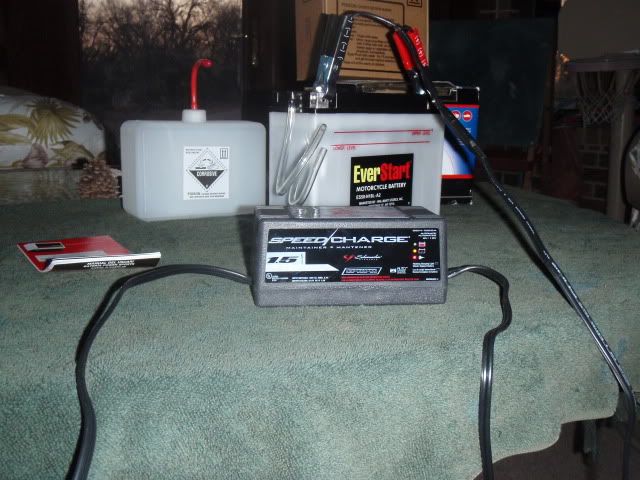
I let it set for one hour after filling with acid and she's charging as we speak at a cool 1.5A
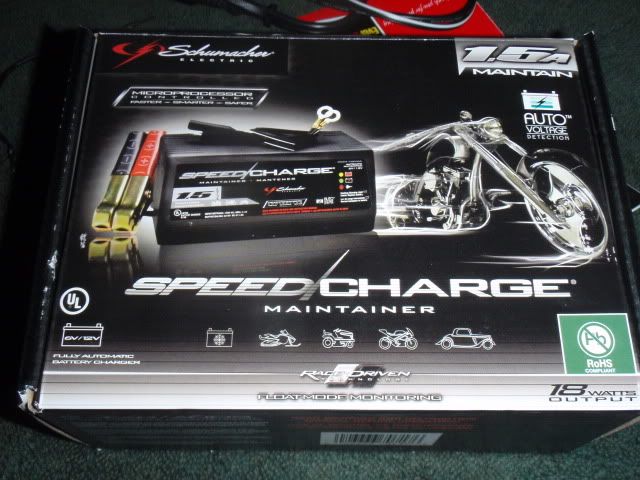
Got one of these at Wal Mart Makes things real simple...just hook it up and let it do its thing. It charges at 1.5A untill fully charged, then goes into maintenance mode. If the voltage drops too low it starts charging again. These have been around for a while, but the first time I've used one. Only cost $20...what the what have I been thinking using my old 20 year old bulk charger all this time and worrying about leaving it on too long
 It won't even let you hook it up backwards
Leave a comment:
-
A wolf What the what

Actually you have to use 3D glasses...its kinda like the Avatar movie...with 3D glasses you see blue alien creatures with long tails
Leave a comment:
-
OK so your getting a new battery and you will be adding the fluid yourself. It's easy enough to do just be clean and CAREFUL with that stuff. Make sure you CHARGE this new battery. The last battery I bought the lad at the counter told me to just fill it and put in in the bike and away I go. WRONG. The instructions say clearly that the battery MUST be charged before it is put into use or SHORT battery life will result. Read the instruction and follow them. Given that the XS1100 does not have a real good charging system do not count on the bike putting that starting charge on the battery. My battery that I did nto charge before putting it into use is 2 years old and will not longer accept a charge... it is TOAST.
RobLeave a comment:
-
That's funny.... all this testing, cleaning, denying and it was just a bad battery.Leave a comment:
-
-
I thought your avatar was a drawring of a wolf!
Shows how obsevant I am.
Leave a comment:
-
Steve,
Will do on the battery charge, and yes, my battery cables are old and cheap.
Don't go too far because I suspect I do have other issues. This may just be one in many.
Thanks to all for the help and great discussion. I'll report back when I know more.
BTW, just how did Larry post those videos That would be helpful if I could post something like that. Larry gets an extra chicken dinner for his video
Leave a comment:
-
HAH!
Well, that does me tell one last thing.... you need better jumper cables. If they had actually been delivering current, it would have started with a jump.
And make sure you properly activate that battery; charge it for at least 12 hours @ 2 amps, 14-16 hours would be better.
'78E original ownerLeave a comment:
-
Oh Man You guys aren't going to believe this...The referees in the replay booth have reviewed the tapes and the ruling on the field is REVERSED Winner winner chicken dinners for all...the battery is BAD
Ok, yesterday I took it to the O'Reilley auto parts store to have it checked. The clerk checked the battery with a hand held device programmed for 350 cca. His initial reading was it was bad. So the manager told him to hook it up on the stress test machine. After about ten minutes it's proclaimed good. So I reported to you that it was good.
Now then, yesterday it read 14 v when I brought it home. This morning it read 12.5 v. Hmmmm
So today I took it to a NAPA store and their hand held device reported it bad. Strike one. So I took it to a different O'Reilley store and they hooked it up on their stress test machine. It reported the battery as bad. Strike two. So I took it to an Autozone store. They used a hand held device that also reported it bad. So three strikes...time to throw this battery in the street.
Well, I really like the maintenance free batteries, but none are available without ordering one. So just to get by I went to Wal Mart and bought an acid fill battery for $45 and a battery maintainer for $20. At least they gave me $9 for my $70 AGM battery Anyway, I'm now only out $56 and should know within a couple of days what the next bottle neck is
Dang I hate messing with battery acid
I'll go charge this new battery up...in the meantime you guys keep hammering out those electronic equations...just don't hammer each other
Leave a comment:
-
Let's throw one more 'test' out there; Larry mentioned hooking the negative battery cable directly to the motor. Very good idea, but take it one more step and it should narrow where to look for the problem a bunch.
Using your 'jumper' vehicle, hook the negative cable directly to the motor case.
Now, without turning on the key, touch the positive cable to the solenoid connection that goes to the starter. Make sure you have good, bare-metal connections! If you have light-gauge cheapo jumper cables, borrow or buy a good set.
No change? Then the problem is in the solenoid-to-starter cable or it's connection at the starter, a bad starter, a poor ground between the starter case and the motor cases, or you have a mechanical problem in the engine causing it to drag (bummer, but you can't rule this out). To eliminate the cable, try connecting the jumper cable directly to the cable connection at the starter. Pull and check the starter for worn bushings, electrical shorts as per the manual. Clean all surfaces to clean bare metal where the starter attaches to the cases.
Spins fast and sounds like Larry's did in his video? Then the problem is the battery (very unlikely, as hooking a jumper battery to the bike should eliminate that as a cause), the solenoid, or the other cables/connections. By leaving the key off, that takes the ignition as a factor totally out of the equation. The starter should spin the motor properly whether the ignition is on or not (again, watch Larry's video; he disconnected/shorted all the spark plugs).
Do the 'farmer test' on the solenoid, and the results here will confirm/eliminate that as the problem. If you bypass the solenoid and get no change, then you have a problem in the cables/connections.
It's possible that you may have multiple problems, but until you methodically eliminate each possibility, it'll only drive you crazy....
'78E original ownerLeave a comment:
-
Just kinda briefly reading these threads and Backing up a ways, I see Ivan diaganosed your problem. Trust what he says, you have a bad battery at the least. At the parts store, they try to be of help, but don't have a clue really when it comes to testing and load testing batteries. Noticed in one of Mashers's threads he said that voltage kept dropping while trying to start. This is a sure sign of a shorted cell, no matter what the static resting volts are. So, in effect he load tested the battery witout having a good carbon pile load tester. Not having a load tester other than the bike, what you can do for your own satisfaction is remove all the fill caps on the battery and watch the cells while cranking it over. If a cell has the least sign of bubbleing, that likely is a shorted cell. A PROPER load test, is hard to find someone who REALLY knows how it's done and what the results tell you. Just for example: an automotive type wet cell battery that is rated at say 800cca would be load tested at approx. 400amp for 15-20sec. Normal voltage drop under this load would down to 10.5-11volts. If it holds that for the load time, it is a good battery. When under that same load for the same approx. period of time, it drops to the 10.5-11volts then gradually keeps dropping with that battery being a known charged battery, it can be for the most part condeemed. There are three more test you can do for complete satisfaction that battery is bad, but for the most part, PROPER load testing will tell the tale. May be retired, but still remember most of this stuff, as I was certified in charging and starting systems on all types of equip. and autos. Also our shop foreman was anal to the point of wanting written documentation of test results, including load testing individual cells with written doc. before authorizing any parts replacement....and a load more stories as you could imagine! Hope something here can be of help so you will have a dependable scoot for the future!Leave a comment:
-
+1 on the impedance. From the symptoms I have heard described, they match what mine was doing after I put the replacement engine in. I had NOT swapped any wires, and was using the same ignition parts from the old engine, and it would just backfire once in a while. After 2 weeks of fighting with it (and making sure I had a fully charged and good working battery) it was suggested that I swap the primary coil wires as someone else had run into the same problem. So I took the tank off, and swapped the wires. I didn't even put the tank back on because I didn't expect it to work. I pushed the starter button and it fired almost instantly. I don't know how it happened, but somehow the coils ended up electrically swapped. It's a 2 minute test, and costs nothing, and swapping the primary wires on the coils just might get it to start.
Give it a try, the symptoms sound exactly like what was happening with mine, and that was the fix.Leave a comment:


Leave a comment: